

2026-09-09
Nural Choudhury
When generative tools make competent content free, the only scarce asset left is proof that a real person made it.
For a decade, marketing rewarded fluency. A brand that could publish more articles, more posts and more variations than its rivals won the visibility game. Generative models have made fluency nearly free. An Ahrefs study of 900,000 new web pages found that roughly three in four already contain some AI-generated text (Ahrefs, 2025). Only about one in four pages in that study were written entirely by a person. Separate tracking by Graphite found AI-authored articles overtook human-written ones in late 2025, at just under 51 per cent of new long-form content (Graphite, 2026). A widely repeated claim that this will reach nine in ten pages by 2026 traces back to a single projection, not a measurement. We treat that figure as directional, not as evidence (The Living Library, 2026).
Fluency was never the real moat. It was a proxy for effort, and effort is now cheap to fake. What remains expensive is the thing fluency used to signal. Someone did the work, checked the facts, and can be held to account if the claim is wrong.
Audiences are already pricing this in. A 2026 Fractl survey tracked how many consumers say heavy AI use would reduce their trust in a brand (Search Engine Land, 2026). That share nearly doubled year on year, from roughly one in five in 2025 to close to two in five in 2026. The same survey found perceived helpfulness of AI-powered search fell sharply over the same period, from roughly four in five down to just over half. Separate December 2025 data from Klaviyo and Datalily found only 7 per cent of consumers say visible AI-generated marketing content makes them trust a brand more (eMarketer, 2026). By contrast, 31 per cent said it makes them trust the brand less. None of this proves AI-assisted content is worthless. It proves visible, unaccountable AI content now carries a discount, and that discount grows as the supply of generic text grows with it.
Regulators are formalising the same instinct. Article 50 of the EU AI Act applies from 2 August 2026 (EU AI Act Explorer, Article 50). It requires providers of generative systems to mark synthetic audio, image, video and text so it is machine-detectable. It also requires anyone publishing AI-generated text on a matter of public interest to disclose that fact (European Commission, 2026). The one exception is content a named human has genuinely reviewed and taken editorial responsibility for. That single carve-out is the whole argument, written into law. The rule does not penalise AI assistance. It penalises AI output passed off as unmediated human judgement.
Platforms are moving the same way from the other side. YouTube has required creators to disclose realistic synthetic content since 2024 (YouTube Blog, 2025). By 2026 it began applying labels itself when creators do not, including on the video player for sensitive topics such as health and finance (YouTube Blog, 2026). Meta now requires an AI-generated label on any ad creative where AI substantially generated or altered the visual or audio content (Meta, 2025). It detects this partly through embedded C2PA provenance metadata. LinkedIn’s own guidance under Article 50 draws the identical line: AI-drafted text you have genuinely reviewed needs no label (LinkedIn Help, 2026). AI text published largely as-is on a public-interest matter does need one. Disclosure is moving from an ethical nicety to an infrastructure requirement. The requirement is always the same: name the accountable human, or say that none exists.
Meanwhile the supply side keeps widening the gap disclosure rules are trying to close. Detection tooling cannot police this reliably on its own. Independent testing puts its accuracy at around 71 per cent on mixed AI-assisted and human-edited text. That gap between how much synthetic content exists and how reliably it can be flagged is exactly why provable authorship becomes the durable signal, not detection. A brand cannot outsource the proof that a person did the work. It can only supply that proof directly, and repeatedly, until the audience trusts the pattern.

Provable authorship is not a tone of voice. It is a set of operating habits a model with no access to your organisation cannot fake.
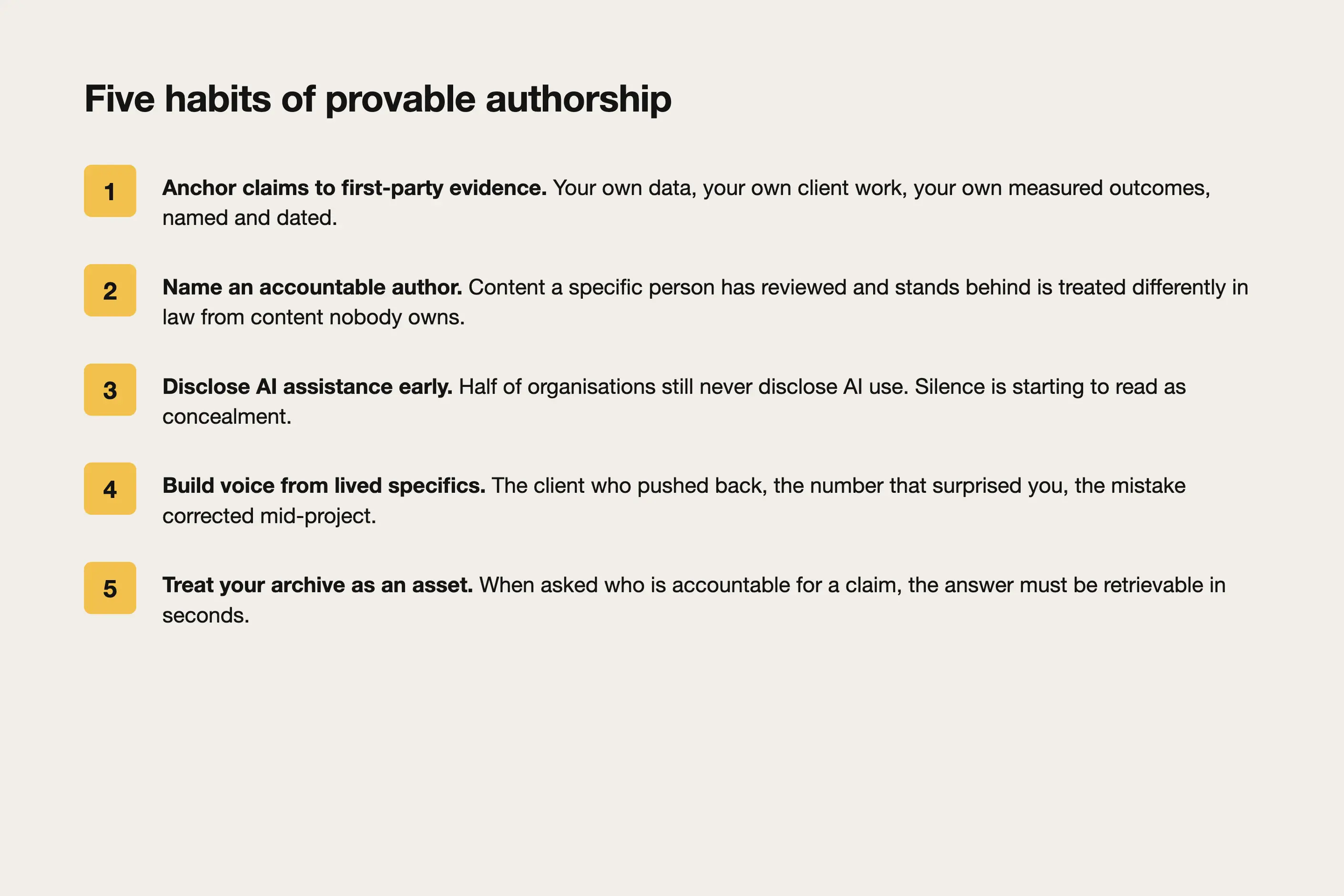
First, anchor every substantive claim to first-party evidence: your own data, your own client work, your own measured outcomes, named and dated. A model can generate a plausible case study. It cannot generate the client’s actual project, the actual measured result, or the actual person who signed off on it.
Second, put a named, accountable author on anything that states a fact or a judgement. The EU AI Act’s own carve-out is instructive here. Content a specific person has reviewed and stands behind is treated differently in law from content nobody owns. Treat that distinction as a design principle for your content operation, not just a compliance line.
Third, disclose AI assistance where it materially shaped the output, and do it before a regulator or a platform makes you. Half of organisations still never disclose AI use, per the same Fractl analysis cited above. Disclosure is fast becoming the trust-neutral default, and silence is starting to read as concealment.
Fourth, build a voice around lived specifics a model has no access to. The client who pushed back. The number that surprised you. The mistake you corrected mid-project. Generic competence is now a commodity. Specific, checkable memory is not.
Fifth, treat your archive of past decisions, sources and reasoning as an asset, not paperwork. When a reader or a regulator asks who is accountable for a claim, the answer needs to be retrievable in seconds, not reconstructed under pressure.
None of this is an argument against using generative tools. It is an argument against letting fluency stand in for proof. The market is already separating the two. Audience trust data, platform labels and binding law are all moving faster than most content calendars have noticed. The brands that name their authors, show their evidence and disclose their tools early will still be trusted once everyone else’s fluent content has become wallpaper nobody reads twice.

No. Trust data shows visible, unaccountable AI output loses trust, not AI assistance itself. Genuine human review and disclosure both preserve credibility, per LinkedIn’s own Article 50 guidance.
From 2 August 2026, AI-generated text on public-interest matters needs disclosure unless a named person genuinely reviewed it. Synthetic audio, image, video and text must be machine-detectable.
No. Independent testing puts accuracy at roughly 71 per cent on mixed AI-assisted and human-edited content. That unreliability is why provable, first-party authorship matters more than detection.
Not always. The consistent legal and platform standard is that genuine human review and editorial accountability remove the need for a label. Undisclosed AI output on public matters still needs one.
Measured studies put it at roughly three in four new pages containing some AI text, with AI-only articles overtaking human-written ones in late 2025. A 90 per cent by 2026 figure is a projection, not a measurement.
Put a named, accountable person behind every claim of fact, backed by first-party evidence. That habit is the hardest thing for a model with no access to your organisation to fake.
Grades: primary means the issuing body’s own publication. Secondary means a credible third party reporting it where the original could not be located. Cut means a figure removed for want of a traceable source.
Two claims were cut for want of a traceable source. One put AI-generated images at 79 per cent across Instagram, TikTok and Pinterest. The other put AI-written long-form posts at 53.7 per cent among LinkedIn’s most-followed voices. Both trace only to vendor and venture-blog write-ups citing an analysis that is not published in full. An article arguing that provable authorship is the moat cannot rest on figures it cannot source.