

2026-09-15
Nural Choudhury
Crazy Eights is a timed sketching exercise: each person draws eight distinct ideas in eight minutes, one per folded panel, to force past the first, safest idea.
The room that keeps circling its first idea, and the meeting where one person’s suggestion sets the direction because nobody generated an alternative to weigh against it.
The sketches are raw material, not a decision. The vote gives you a shortlist you can carry straight into a scoring pass through an idea evaluation matrix, or into the Design Sprint’s Decide phase if you are running inside that process.
Each participant’s folded sheet of eight sketches, the group’s dot-voted shortlist, and whatever a follow-on selection step, a scoring pass or a themed sort, produces from it.
Jake Knapp built the exercise inside the Design Sprint process he developed at Google from 2010, while working on Gmail, Chrome and Google+. He refined it with Braden Kowitz, John Zeratsky, Michael Margolis, and Daniel Burka at Google Ventures, and three of the four wrote it up publicly in “Sprint” in 2016.
The name comes from the fold, not a flourish. Fold a sheet of paper in half three times, and it opens into eight equal panels, one per idea, which is where the exercise gets its number.
In the book’s five-day structure, Crazy Eights runs on Tuesday, the Sketch day, after Monday’s problem mapping and before Wednesday’s Decide phase narrows the sketches to one direction. It is one exercise inside that day, not the whole day: a team typically runs faster warm-up sketching first, then Crazy Eights, then a slower, more detailed solution sketch.
The constraint is deliberate, not arbitrary. A minute a panel leaves no time to weigh whether an idea is good while drawing it, and that gap, the pause to judge, is what keeps most people circling their first, safest concept instead of reaching a fourth or fifth.

Prepare before you start the clock. Share any relevant research, current-state screenshots, or known constraints with the group beforehand, since sketches sharpen when people understand the problem space, not just the one-line challenge.
I don’t close a session without the selection step already booked, dot voting on the spot, or a scoring slot on the calendar. A pile of sketches with nothing lined up behind it stalls before it ever becomes a decision.
I say out loud, before the clock starts, that drawing skill is not the test: boxes, arrows, and stick figures are sufficient, and a rough mark is worth more than a blank panel. Adjust the constraint rather than abandon it when eight minutes does not fit: Crazy Fours, four ideas in four minutes, suits a narrower problem, and a distributed team can run the identical exercise on a shared digital whiteboard instead of paper.

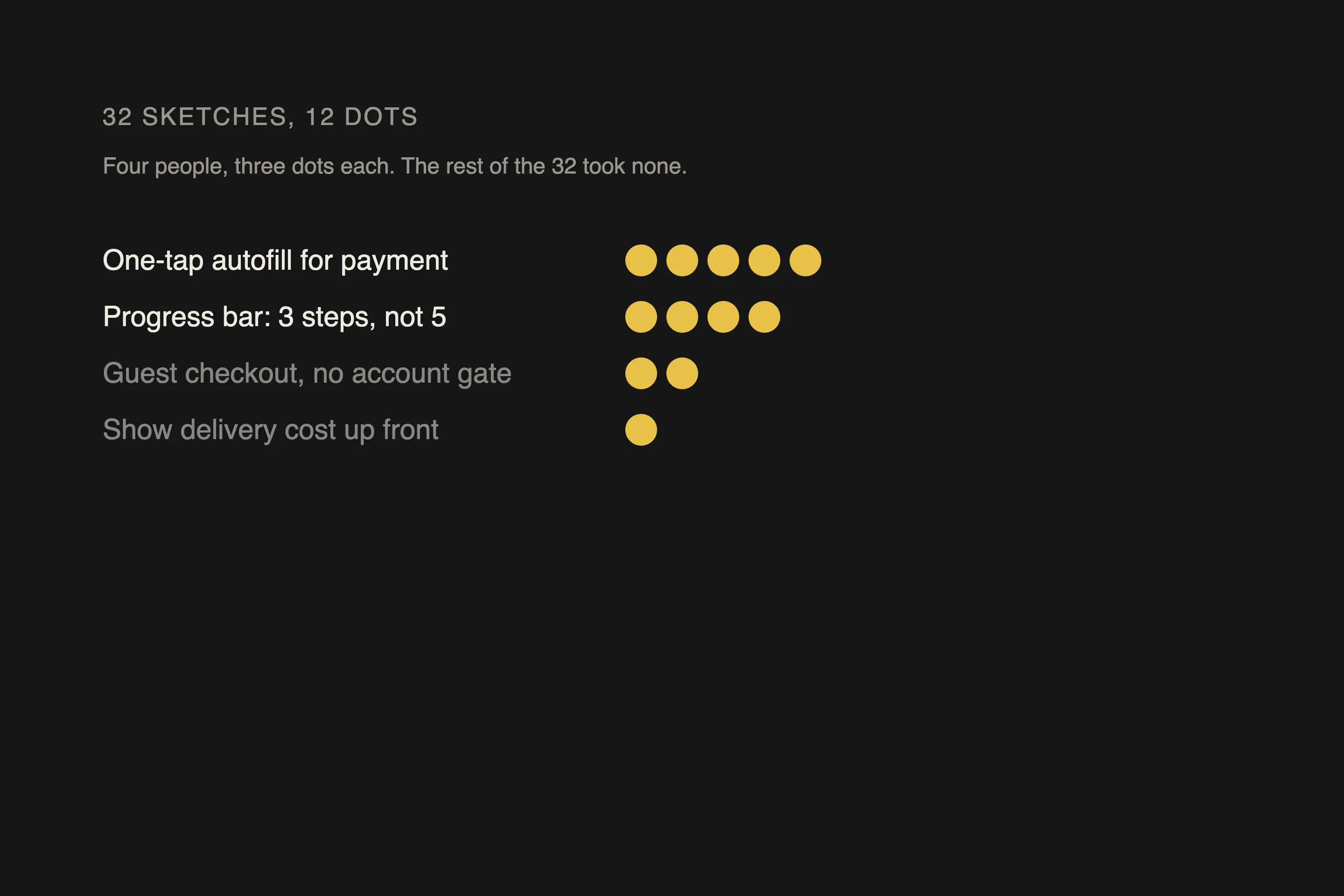
A four-person team is sketching solutions to cut cart abandonment on a checkout page. Each person folds a sheet into eight panels and sketches for eight minutes: four people, eight ideas each, thirty-two sketches on the table before a discussion-first meeting would still be debating the brief. One sketch replaces the payment step with a single autofill button. Another removes the account-creation gate. A third adds a progress bar showing three steps instead of five.
After a minute of individual review, each person presents their eight sketches in under a minute, then the group votes: three dots each, twelve dots distributed across thirty-two sketches. The autofill idea and the progress bar collect the most votes and move forward as solution sketches. The rest go into an idea repository that nobody deletes, because next quarter’s problem might be the one they solve.
I have watched this exercise reward fast, confident drawing over good thinking, more times than I can count. A participant who sketches quickly fills all eight panels with something. In contrast, a participant who freezes at a blank page, often someone with less design confidence rather than less insight, produces thin, rushed sketches regardless of how strong their thinking is. The vote that follows scores what got drawn, not what got thought.
The failure I see most often is eight variations of one idea, not eight ideas. Under time pressure, most people’s second sketch elaborates their first rather than replacing it, and by panel eight the sheet shows one concept refined eight times. I catch this by walking the room mid-round and telling people directly to try an opposite direction, because left alone the room converges by default.
Thirty-two sketches are not a decision, and I have watched teams treat them like one anyway. Crazy Eights generates raw material and stops there. Without a structured selection step afterwards, dot voting, a themed sort, or a scoring pass through an idea evaluation matrix, the sketches sit in a folder, and the team defaults back to whoever argued loudest in the room.
Reach for something else when you already know the direction and need to develop it, when the problem is a system with dependencies a sketch cannot show, when technical or business constraints have already ruled out most of the solution space, or when the decision genuinely needs one expert’s judgement rather than eight people’s first thoughts. Crazy Eights is an exploration tool. Point it at a decision that is already made, and it wastes eight minutes producing sketches nobody was free to draw.
Jake Knapp built it into the Design Sprint process at Google in 2010, and refined it at Google Ventures with Braden Kowitz, John Zeratsky, Michael Margolis, and Daniel Burka. It reached a wide audience through Knapp, Zeratsky and Kowitz’s 2016 book, “Sprint”.
Eight minutes of sketching, plus a minute of individual review and roughly a minute per person to present. A four-person team can run the whole exercise and a first vote in under twenty minutes.
Because the first idea people reach for is rarely the best, and there is no way to know which of the eight will turn out strongest until they are all on the table.
Boxes, arrows, and stick figures are the standard vocabulary. The exercise measures whether an idea got externalised, not whether the sketch is good art.
They go through a selection step, dot voting at minimum, or a structured pass through an idea evaluation matrix, before anyone commits time to developing one. Sketches with no selection step behind them are not a decision, just paper.
| Fact | Detail |
|---|---|
| Proper name | Crazy 8s, also written Crazy Eights |
| Origin | Built by Jake Knapp inside the Design Sprint process he developed at Google from 2010, while working on Gmail, Chrome and Google+ |
| Refined by | Braden Kowitz, John Zeratsky, Michael Margolis, and Daniel Burka, alongside Knapp at Google Ventures |
| First publication | “Sprint: How to Solve Big Problems and Test New Ideas in Just Five Days”, Jake Knapp with John Zeratsky and Braden Kowitz, Simon & Schuster, 2016 |
| Format | A sheet of paper folded into eight equal panels, one distinct idea sketched per panel, eight minutes total |
| Where it sits in the Sprint | Day two, the Tuesday Sketch phase of the five-day Design Sprint, ahead of Wednesday’s Decide phase |

A design sprint is a five-day process that takes a team from a business problem to a tested prototype, revealing whether an idea works before it is built.
Read it
Mind mapping is a technique for organising ideas around a central topic using branching, radial diagrams instead of linear lists.
Read it
SCAMPER is a seven-lens checklist: substitute, combine, adapt, modify, put to another use, eliminate, rearrange, for generating ideas about something that already exists.
Read it
An idea evaluation matrix is a structured scoring tool that ranks competing ideas against a shared set of weighted criteria, typically value, effort, and risk, so a team can compare options that all look plausible consistently rather than by whoever argues loudest.
Read it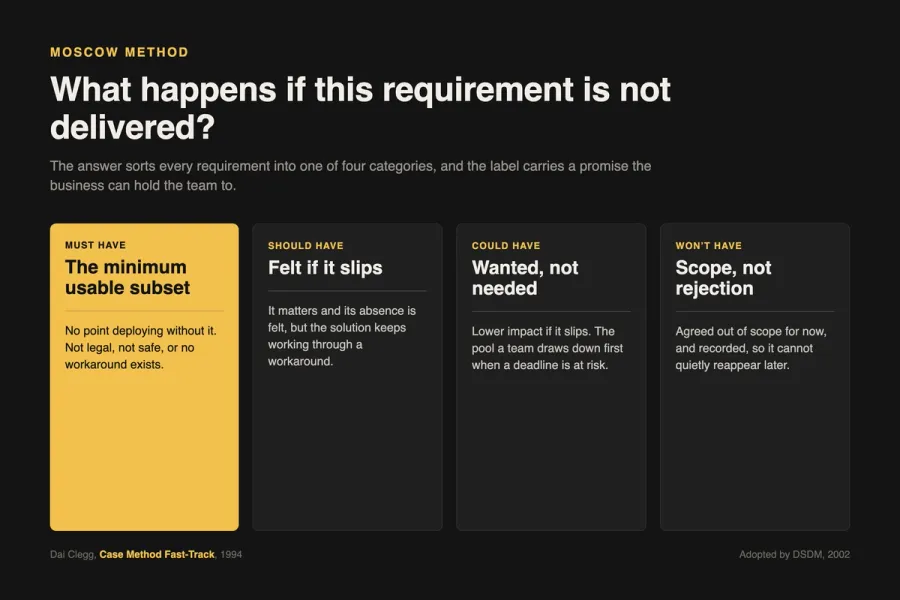
The MoSCoW method is a requirements-prioritisation technique that sorts features into Must Have, Should Have, Could Have, and Won’t Have, protecting a fixed delivery date without cutting corners nobody chose to cut.
Read it