

2026-09-15
Nural Choudhury
SCAMPER is a seven-lens checklist: substitute, combine, adapt, modify, put to another use, eliminate, rearrange, for generating ideas about something that already exists.
A team stuck on an existing product or process with no idea where to change it, and a brainstorm that keeps returning the same few obvious answers. SCAMPER needs a subject with parts to interrogate; it will not move against a blank page or an abstract goal.
Take the ideas it produces into an idea evaluation matrix before committing resources to any of them. SCAMPER generates volume, not quality, so the output needs a scoring pass before you decide.
A lens-by-lens idea set across all seven transformations, a voted shortlist of two or three ideas with an owner named against each, and the ready-to-use prompt bank, thirty-five questions across the seven lenses, to run the next session against a new subject.
Alex Osborn, the advertising executive who coined “brainstorming”, published an idea-spurring checklist of questions in his 1953 book “Applied Imagination”. The checklist asked what could be adapted, modified, magnified, minified, substituted, rearranged, combined, or reversed about an existing idea- the same seven moves SCAMPER now organises under one mnemonic.
Bob Eberle, an American school administrator, took that checklist and arranged it into the seven-letter acronym in his 1971 book “SCAMPER: Games for Imagination Development”. Eberle was not writing for business leaders. He built the tool to teach creative thinking to schoolchildren, and the mnemonic’s simplicity- seven letters mapped to seven verbs- was designed for a classroom exercise, not a boardroom one.
Design and innovation teams adopted Eberle’s mnemonic decades after he wrote it, pointing the same seven questions at products, services, and business models instead of the classroom exercises he designed it for. The logic travelled well because it was never tied to a particular subject: each lens forces a specific kind of transformation, regardless of what sits in front of the group. The audience changed, not the method.

A full run costs about 75 minutes for a group of five to eight people.

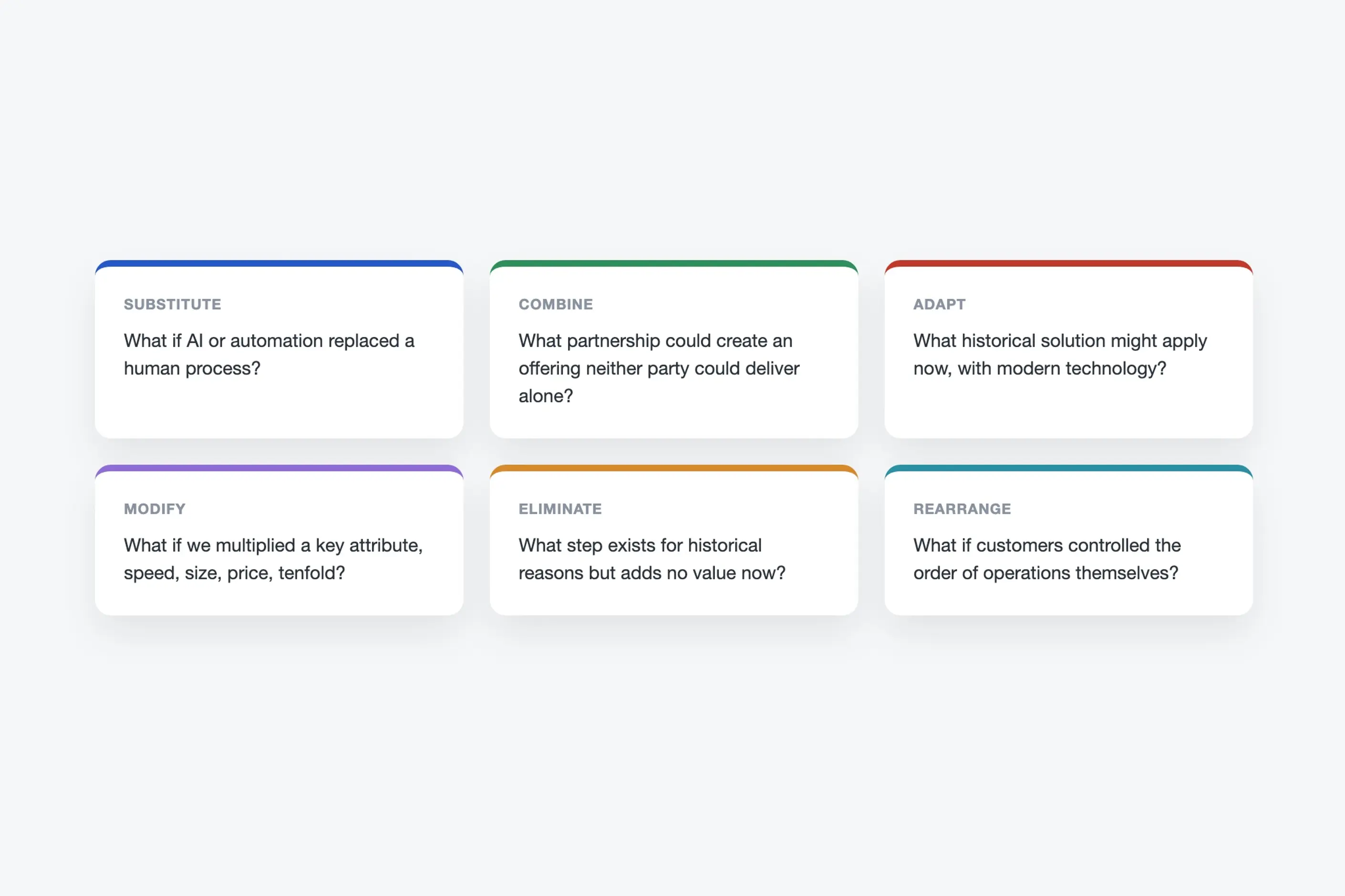
Examine each part of your subject, materials, people, process, timing, or approach, and ask what could take its place.
What can we substitute or change in our product, problem, or process?
A restaurant replaced human order-taking with tablet ordering. Staff moved from taking orders to serving tables, and both errors and wait times fell. An email client replaced threaded conversations with a single priority-based stream. That changed how people work through their inbox.

Look for value created by merging separate elements, so the result does more than either part did alone.
How can we combine two or more parts of our product, problem, or process, so the whole does more?
UK offset mortgage accounts combine a savings account and a loan account in one product. A customer’s savings reduce the interest charged on their mortgage, and they keep access to the money. Starbucks combined a coffee shop with somewhere to sit and work, and built its positioning around the “third place”, a term the sociologist Ray Oldenburg coined for a social space that is neither home nor work.

Look outward, to other industries, other contexts, other time periods, for a solution that might transfer.
What can we adapt from elsewhere into our product, problem, or process?
Self-checkout systems adapted the airline kiosk check-in model for retail. Hospital teams have adapted aviation’s pre-flight checklist into surgical safety checklists, a shift credited with fewer preventable errors in operating theatres. Velcro adapted the way burr seeds hook onto fur: the Swiss engineer George de Mestral noticed it on a dog walk in 1941 and patented the hook-and-loop fastener a decade later.

Explore changes in scale, intensity, frequency, or form. This lens covers both magnifying and minifying an attribute.
What can we modify, or emphasise more or less, in our product, problem, or process?
Same-day delivery shifted the e-commerce fulfilment timeline and became a speed competition. Tapas restaurants shrank the portion, and turned dining from individual plates into shared exploration. Micro-learning platforms cut lesson length from hour-long sessions to five minutes, matching the format to how people give attention today.

Reframe the product or capability itself. Ask what other problem it might solve, what other audience it might serve, what other context it might fit.
How can we put the thing to other uses?
Pfizer originally developed sildenafil, sold as Viagra, for heart conditions. A side effect became the product. Bubble wrap was originally designed as textured wallpaper; its second life as packaging material built an entirely different business. Baking soda found new uses in cleaning, deodorising, and personal care long after it started as a baking ingredient.

Fight complexity and feature creep by questioning necessity. Often the most successful products win through removal rather than addition.
What can we eliminate or simplify in our product, design, or service?
Apple has removed a component with nearly every major redesign: the floppy drive from the original iMac in 1998, the optical drive from the MacBook Air, the headphone jack from the iPhone 7. Each removal drew complaints at launch and was followed within a few years by the rest of the industry. Twitter, now X, eliminated long-form posting; the character limit became a communication style in its own right, not a constraint people resented.

Examine sequence, layout, hierarchy, and structure. Reordering often changes the experience more than any single addition or removal would.
How can we change, reorder, or reverse the product or problem?
Letting a customer check out as a guest, rather than forcing registration first, reverses the traditional browse-then-register sequence and often improves conversion. Netflix and the streaming services that followed it rearranged television from scheduled programming to on-demand access. IKEA rearranged the furniture shopping sequence, placing the warehouse after the showroom rather than treating them as separate visits.
through all seven lenses individually, three techniques generate ideas the single pass misses. Combine two lenses in one prompt, “what could we substitute and eliminate at the same time?”, since the most useful ideas often sit at the intersection. Add a harsh constraint after the first pass, “now do this again assuming the budget is 10 per cent of what it is today”, since a real constraint forces answers a comfortable brief never will. Or run SCAMPER in reverse: ask how to make the subject worse on purpose, then invert every answer into something to avoid.

Substitute
Combine
Adapt
Modify
Put to another use
Eliminate
Rearrange
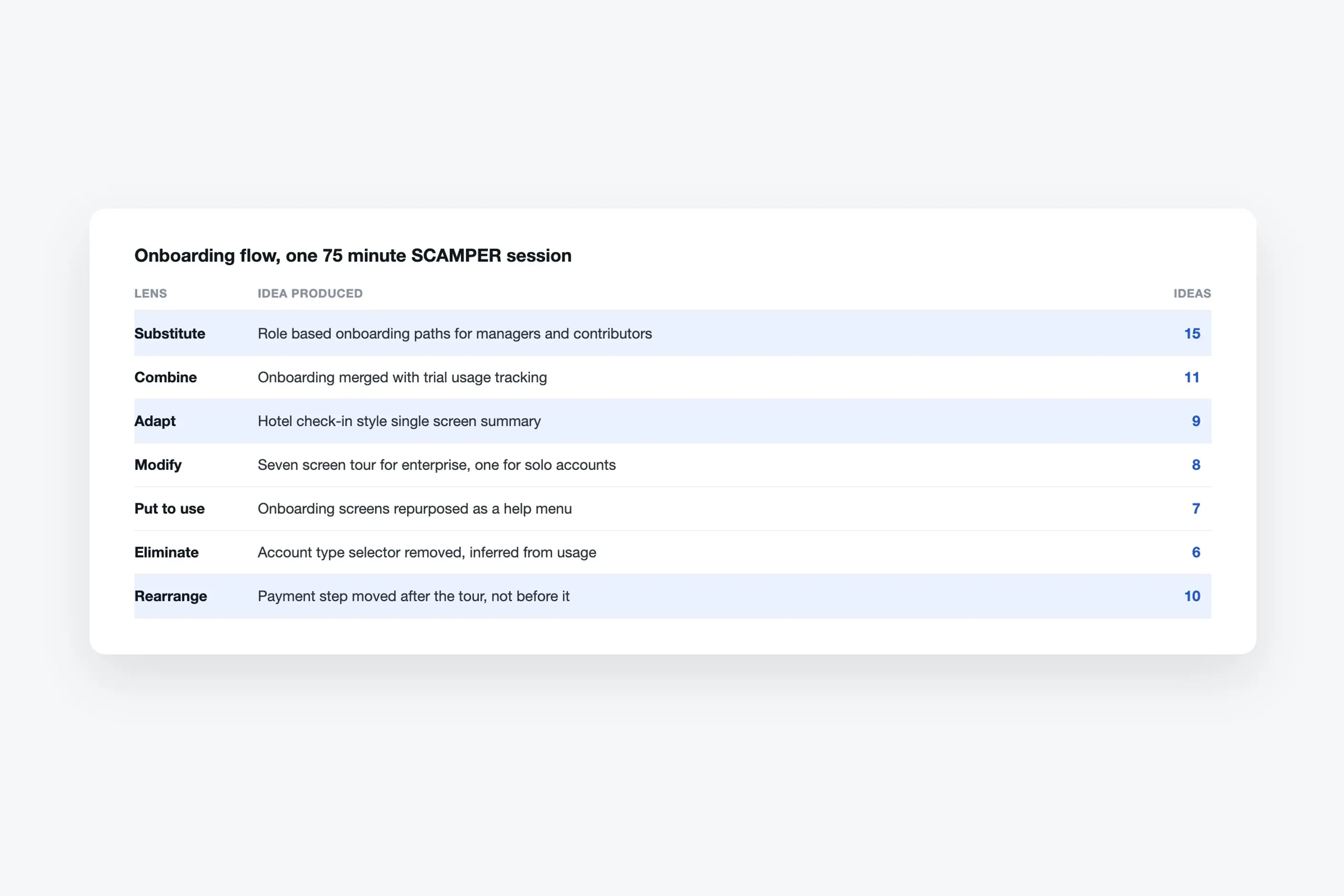
Take one subject: a project management app’s onboarding flow, the screens a new user sees in their first ten minutes. A team of six runs a single 75-minute session against it.
Substitute produces the most ideas early: swap the tour video for an interactive checklist, swap default sample data for the user’s own first project, swap a single onboarding path for role-based paths for managers and individual contributors. Fifteen ideas in five minutes.
Combine merges onboarding with the trial’s usage tracking, so day-one behaviour flags the features a new user needs to see next. Eleven ideas.
Adapt borrows a mobile game’s progress bar to show setup completion, and a hotel check-in app’s single-screen summary before the tour starts. Nine ideas.
Modify stretches the tour from three screens to seven for enterprise accounts, which need more configuration, and shrinks it to one screen for solo accounts, which need almost none. Eight ideas.
Put to another use repurposes the onboarding screens as a permanent help menu, since much of what a new user needs to see, an existing user asks for again in month three. Seven ideas.
Eliminate removes the account-type selector entirely, sending every signup down one path and inferring account type later from usage. Six ideas.
Rearrange moves the payment step from before the tour to after it, so users experience the product before being asked to commit money. Ten ideas.
Sixty-six ideas across seven lenses in 35 minutes of generation. The team votes with three sticks each, narrows to three ideas, the role-based path, the check-in-style summary screen, and moving payment after the tour, and spends the remaining 25 minutes turning each into a one-paragraph brief with a named owner.
SCAMPER’s structure guarantees output: seven lenses, each one forces at least a few ideas even from a team with nothing much to say. That guarantee is also the weakness: a forced idea is not a good idea, and I have ended sessions with 60 ideas and no way to separate the strong three from the other 57. I pair a SCAMPER session with a scoring pass; an idea evaluation matrix works well before I call any of it progress.
The seven lenses stay distinct only when the subject is concrete. Point SCAMPER at something abstract, “improve our culture” or “be more innovative”, and I watch Substitute, Adapt, and Combine collapse into the same handful of generic answers, because there is no component to substitute and no object to combine. I will not run the method on a goal, only on a subject with parts: a policy, a product screen, a single process step.
Every lens asks what to change about an existing thing. I find SCAMPER useless in front of a genuinely blank page, no current product, no current process, nothing built yet to interrogate. When a team has nothing on paper, I reach for a generative method such as crazy eights or mind mapping first, then bring SCAMPER in afterwards to work on what the team has made.
Brainstorming has no structure beyond quantity, so ideas tend to cluster around whatever the loudest voice in the room reached for first. SCAMPER forces the group through seven specific transformation types in turn, so teams can’t unconsciously skip the uncomfortable ones.
None on its own, but Eliminate is the one teams skip most often, because removing something feels riskier than adding it. Teams that force themselves through Eliminate anyway tend to find its ideas among the strongest.
There is no fixed target worth chasing. What matters is coverage across all seven lenses. If one or two produced almost nothing, the subject was probably too abstract for that lens, not that the team ran dry, and a narrower subject is worth trying before repeating the session.
Yes. Every lens asks about a component, and a service has components just as a product does: touchpoints, steps, timing, the people delivering it. The questions transfer without much rewording.
Regularly enough to build fluency with the questions, rather than as a one-off exercise pulled out only when a big decision is stuck. A monthly session on a real, current problem builds more skill than an annual one on a hypothetical.
| Fact | Detail |
|---|---|
| Checklist originator | Alex Osborn, advertising executive and co-founder of BBDO, who coined “brainstorming” and published an idea-spurring checklist in “Applied Imagination”, 1953 |
| SCAMPER creator | Bob Eberle, an American school administrator, who arranged Osborn’s checklist into the seven-letter mnemonic and published it in “SCAMPER: Games for Imagination Development”, 1971 |
| Original audience | Schoolchildren. Eberle built SCAMPER to teach creative thinking in the classroom, not to run business workshops |
| The seven lenses | Substitute, Combine, Adapt, Modify, Put to another use, Eliminate, Rearrange |
| Current status | A standard ideation technique taught in innovation and design training, decades after its classroom origin |

Crazy Eights is a timed sketching exercise: each person draws eight distinct ideas in eight minutes, one per folded panel, to force past the first, safest idea.
Read it
Mind mapping is a technique for organising ideas around a central topic using branching, radial diagrams instead of linear lists.
Read it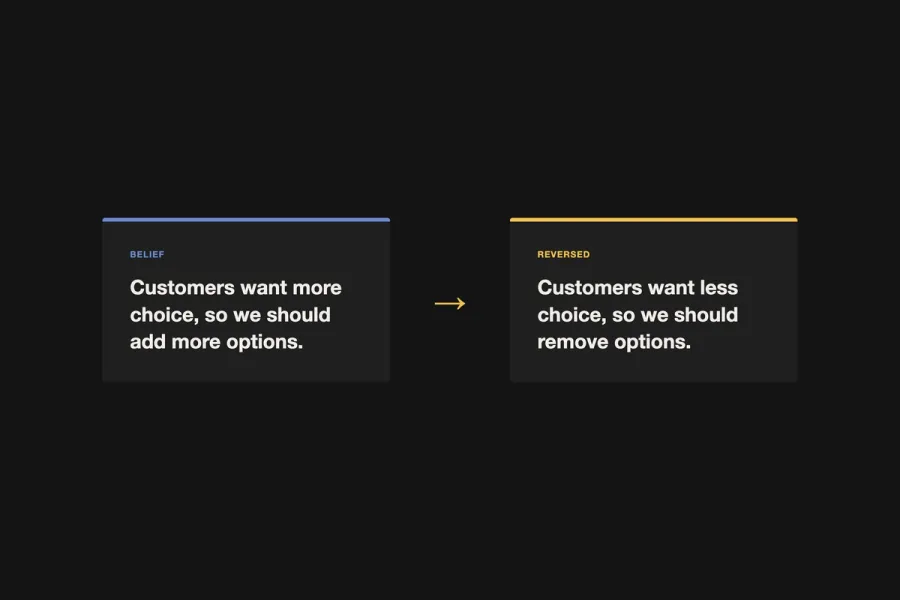
Opposite thinking, also called assumption reversal, surfaces the hidden assumptions in a problem statement, inverts them, and uses the inversions as prompts for new solutions.
Read it
An idea evaluation matrix is a structured scoring tool that ranks competing ideas against a shared set of weighted criteria, typically value, effort, and risk, so a team can compare options that all look plausible consistently rather than by whoever argues loudest.
Read it
A design sprint is a five-day process that takes a team from a business problem to a tested prototype, revealing whether an idea works before it is built.
Read it