

2026-09-15
Nural Choudhury
A team isn’t misaligned because it lacks a vision; it is misaligned because the cadence that surfaces disagreement before it hardens doesn’t exist.
Alignment is a meeting-design problem rather than a communication one, and the fix is a fixed review rhythm, not a better deck or a clearer slide.
A design team whose roadmap has quietly drifted from the company’s priorities, and a leader who only finds out when a decision lands that nobody in design saw coming.
Run a review rhythm across three intervals that catches drift. At the same time, it is still a course correction, and trace every design objective to a business one a stakeholder outside design already recognises.
A weekly work review, a monthly metrics session, a quarterly objective reset, and a standing test for telling a design metric from a vanity one.
Objectives and Key Results (OKR) is the framework design teams most often borrow to make the trace from design work to business goals explicit. Andy Grove developed it at Intel in the early 1970s, building on Peter Drucker’s earlier management-by-objectives model and adding a measurable key result with a quarterly review cycle.
John Doerr learned the method from Grove at Intel and introduced it to Google’s founders in 1999, a year after the company’s founding. He later set out its full history in his 2018 book Measure What Matters.
The cadence this page describes borrows OKR’s discipline rather than its full apparatus: an objective states a direction, and its key results are numbers that already mattered to someone outside the team that set them.
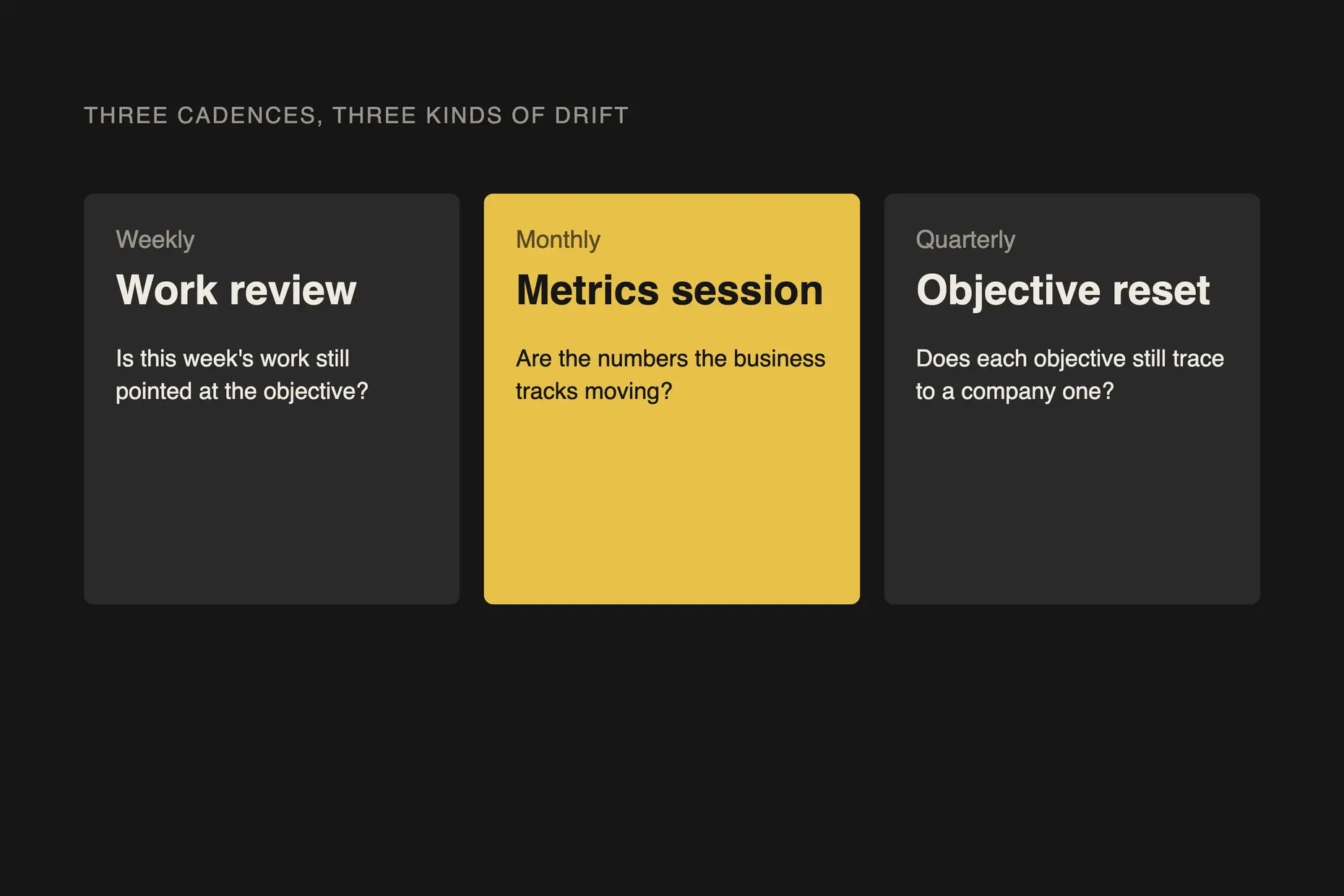
Run three cadences at three different intervals. Each answers a different question and catches a different kind of drift.
| Cadence | Question it answers | Typical format | Who attends |
|---|---|---|---|
| Weekly | Is this week’s work still pointed at the quarter’s objectives? | Short team stand-up or work review | The design team and its lead |
| Monthly | Are our metrics moving, and do they still matter to the business? | All-team session reviewing company and design metrics together | The whole design team, sometimes a business stakeholder |
| Quarterly | Do our objectives still serve the company’s, or has the company moved? | Objective-setting or reset session | Design leadership and the function’s business sponsor |
You must run the weekly review even when it feels disposable. It is the cheapest place to catch drift, and skipping it lets a week of misdirected work compound into a month of it.
You must trace every design objective to a company objective in one sentence. “Reduce onboarding drop-off” traces to a stated revenue or retention goal; “ship a new component library” does not, unless the sentence names the business outcome the library serves.
You must demonstrate impact on metrics the business already tracks: engagement, conversion, retention, and satisfaction, rather than a number design invented because no one else could check it.
When the company changes direction mid-quarter, you must re-plan the objective inside the next scheduled review rather than pausing the whole cadence. The cadence stays fixed; only the content reviewed inside it moves.

I do not hold this cadence for a lead forever. I set the rhythm and sit in the room for the first quarter, then hand the weekly and monthly reviews to the lead and keep only the quarterly reset, because that is the one where the company’s own goals are in the room and a lead newer to the business needs backing.
What I check without running it myself is whether the trace still holds: can the lead complete the sentence from a design objective to a business one without me prompting them? If they cannot, I do not write the sentence for them. I ask what the objective is protecting, and let the gap sit until they answer it themselves.
The conversation that goes wrong is when a monthly review turns into a status update: everyone reports what shipped, and nobody says what the numbers mean. When I catch that happening, I stop the meeting and ask one question instead: which of these numbers would worry us if it did not move next month? That question puts the metrics review back where it belongs.
I know a lead has got it when they cancel a piece of in-flight work themselves, in the room, before I would have raised it. A team that agrees on everything in a review has usually stopped arguing and started aligning; a team that still disagrees, but disagrees within the cadence rather than after a decision has already landed elsewhere, is the one that has got it.

At EY, the monthly metrics review was the cadence that did the most work. The design team and I sat in the same room as the company metrics leadership, who were already reporting on the same numbers, and watched them move together.
That review caught a drift the weekly stand-ups had missed: a design objective that had traced cleanly to a business goal three months earlier no longer did, because the business goal itself had moved. We rewrote the objective in the same session rather than waiting for the quarterly reset, and the team could see, in the room, why the old objective no longer earned its place.

The clearest sign alignment has failed is when design hears about a strategic decision, a repositioning, or a cancelled initiative after it has already been made and communicated elsewhere. A genuinely aligned team sits close enough to the company’s decision-making cadence to be part of the conversation that produces the decision, not a downstream recipient of its outcome.
The cadence itself fails quietly before that, in three ways I have seen repeat:
None of these is fatal on its own. Left unaddressed, each arrives at the same place: a team that finds out last.
How often should a design team check alignment with company goals:
Three cadences: weekly against the quarter’s objectives, monthly against company metrics, and quarterly to reset the objectives themselves. Skipping the weekly check lets drift compound before anyone notices it.
What is the difference between alignment and communication:
Communication states intent once, in a deck or a kickoff. Alignment is the repeated check that the intent still holds as both the team’s work and the company’s priorities move.
Are OKRs required for design team alignment:
No. OKR is one framework for tracing design objectives to business ones, and the discipline- an objective with a measurable result someone outside the team already cares about- matters more than the specific format.
How do you know if a design metric is a vanity metric:
Ask whether the business was already tracking the number before design did. One invented to describe only design’s own output is the vanity metric; one the business already reports on is not.
How do you tell a team that agrees from a team that has stopped arguing:
A team that agrees on everything in a review has usually stopped bringing disagreement into the room. A team that still disagrees, but disagrees inside the cadence rather than after a decision has landed elsewhere, is the one that has aligned.
| Fact | Detail |
|---|---|
| Framework most often borrowed | Objectives and Key Results (OKR) |
| OKR originator | Andy Grove, at Intel, early 1970s, building on Peter Drucker’s management-by-objectives model |
| OKR popularised | John Doerr, introduced the method to Google’s founders in 1999 |
| OKR’s full history | Measure What Matters, John Doerr, 2018 |
| Review cadences | Weekly work review, monthly metrics review, quarterly objective reset |
| Clearest failure signal | Design learns of a strategic decision after it has been made and communicated elsewhere |

Design earns a strategic seat by demonstrating value, not by asking for one.
Read it
Design documentation earns its keep when it removes a decision from a developer’s inbox, not when it is complete.
Read it
The Eisenhower Matrix is a prioritisation tool that sorts work into four quadrants by urgency and importance, so a leader spends deliberate time on what matters instead of only reacting to what shouts loudest.
Read it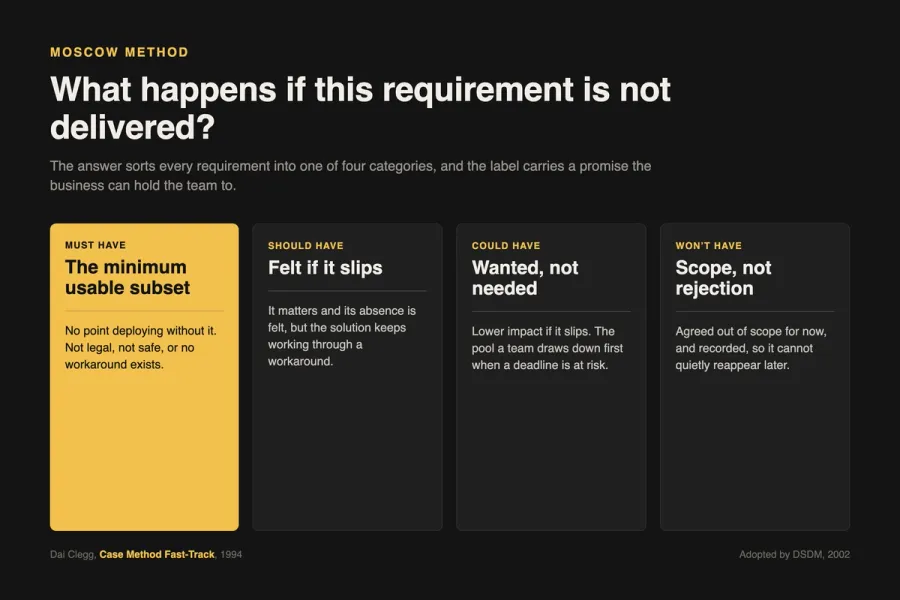
The MoSCoW method is a requirements-prioritisation technique that sorts features into Must Have, Should Have, Could Have, and Won’t Have, protecting a fixed delivery date without cutting corners nobody chose to cut.
Read it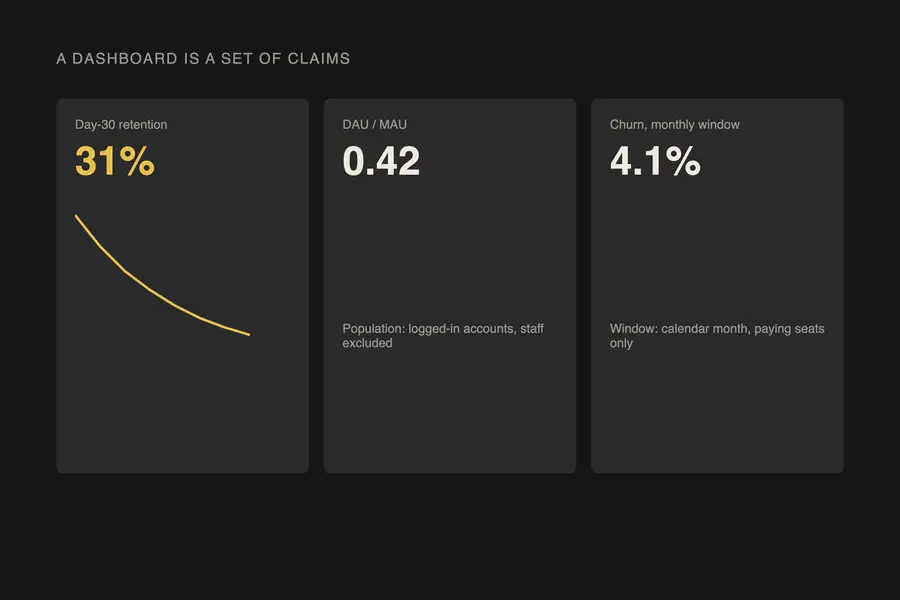
Choosing a product metric is a design decision, not an analytics task, because the metric you pick decides the behaviour a team produces.
Read it