

2026-09-15
Nural Choudhury
A diary study is a longitudinal research method in which participants record their behaviour and experience in their environment over days or weeks, revealing patterns that a single session cannot.
the argument about how a product fits into someone’s routine, which a one-hour session cannot settle because the behaviour happens over days or weeks, in the participant’s own context, without a researcher present to shape it.
point to a pattern that repeats across people and over time rather than one account, which feeds Task Analysis when a single session will do, or Service Blueprints when the next question is which touchpoint the behaviour touches.
the entry corpus itself, structured fields and open text from every participant across the study window, a chronological read followed by the thematic coding across participants, and the synthesis that names the pattern the entries converge on.
John Rieman named and formalised the diary study at INTERACT ’93 and CHI ’93, writing from the Department of Computer Science and Institute of Cognitive Science at the University of Colorado, Boulder. His problem was specific: laboratory usability testing produced results that barely touched real system design, while informal workplace observation produced anecdotes nobody could generalise from. He built the diary study to sit between the two, pitched as a way to raise the objectivity of field data, not to add texture to a report that had already reached its conclusions.
Most retellings lose that framing. Diary studies now travel through UX practice as a softer, more human companion to usability testing, when the original argument was the opposite: a structured tool built to make field research defensible on its own terms.
The method also has an older sibling. Reed Larson and Mihaly Csikszentmihalyi published the experience sampling method in 1983, a decade before Rieman’s paper, asking participants to log a brief report whenever a random signal interrupted their day. Ladd Wheeler and Harry Reis gave the whole family its vocabulary in 1991: interval-contingent entries at fixed points, signal-contingent entries at random prompts, and event-contingent entries triggered by an activity happening. A modern diary study is usually the first or the third of these. Experience sampling is the second.

State the single thing you need to learn, and name the behaviour you are tracking, before you write a single entry prompt. A diary study answers how something unfolds over time, not whether it works, so if you already know the answer is a single verdict, run a usability test or a survey instead and save the weeks a diary study costs.
Screen candidates on their capacity to sustain the study, not only on whether they match your target user. A missed pay cycle, a house move, or a new job pulls a participant out of a study faster than a mismatched demographic does, so ask what else is happening in their life over the study window before you confirm them.
Pick interval-contingent, signal-contingent, or event-contingent entries, depending on whether you need a steady rhythm, a random sample of a day, or a response to something specific happening. Treat duration as a trade-off against fatigue, not a fixed rule. I run a study long enough to see a weekly pattern, or just long enough to catch a single use of a feature, then stop, because every extra week raises the odds a participant stops logging before the study ends.
Mix a handful of fixed fields, such as time, place, and a short rating, with one open prompt for whatever a fixed field would miss. Keep a single entry to two or three minutes: every extra minute makes the next entry likelier to be skipped, so protect that budget from the start rather than trying to recover it once compliance drops.
Show real example entries, not a blank form, so participants see the level of detail you want rather than guessing. Tell them how you will store and anonymise what they write, and get their consent before the first entry goes in, so privacy is agreed before the data exists rather than negotiated after.
Send reminders tied to the entry trigger you chose, not a generic daily nudge, and respond to entries as they arrive so participants feel real, not ignored. Ask a clarifying question about what someone wrote only after the study window closes for that entry, because a live follow-up shapes the next entry toward whatever you asked about, defeating the point of an unprompted record.
Read every participant’s entries in the order they were written before you code anything, so you see the story before you see the pattern. Once the timeline is familiar, code thematically across participants, and treat entries that arrive in the same week from unrelated participants as the signal worth chasing first.
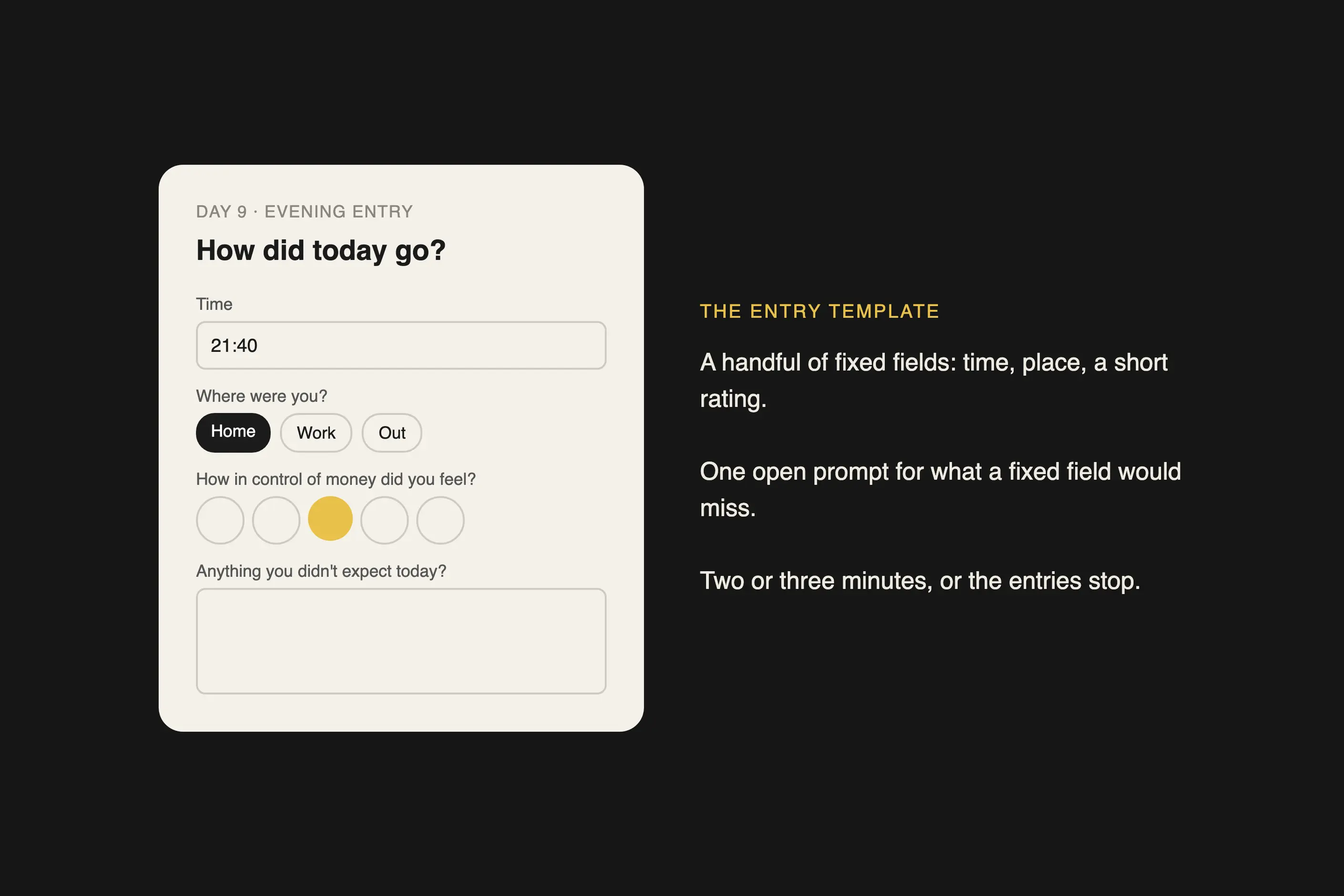
Say you are studying how people manage a household budget across a full pay cycle. You recruit ten participants paid monthly, choose a four-week interval-contingent design with one entry every evening, and add an event-contingent prompt triggered whenever someone makes an unplanned purchase.
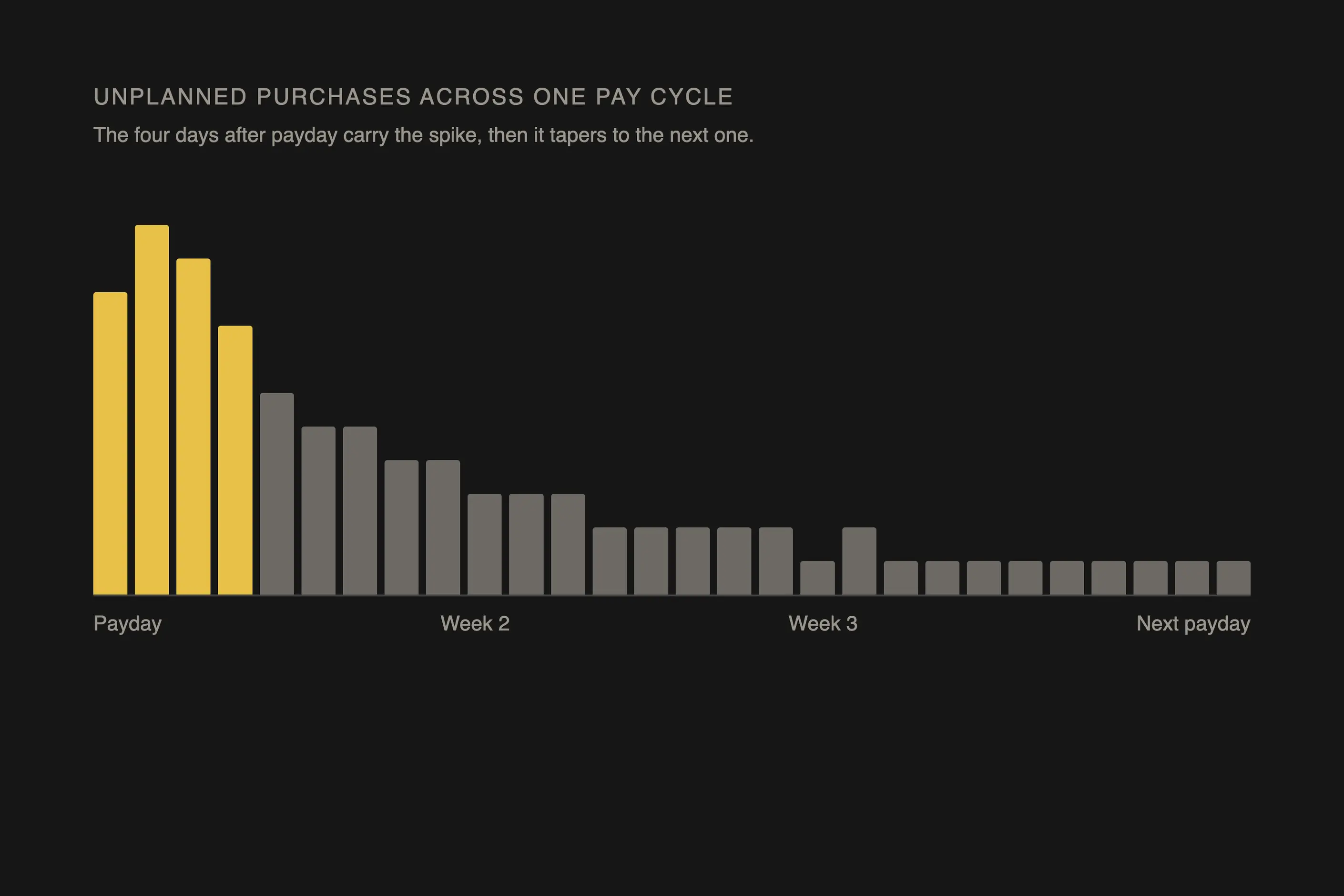
By week two, seven of the ten are still logging every evening. The other three have dropped to two or three entries a week, which suggests the fatigue point sits around day ten for this group, not the four-week mark you planned around. The evening entries show a spending rhythm nobody predicted: a spike in small, frequent purchases in the four days after payday, tapering steadily until the next one, with the event-triggered entries clustering almost entirely inside that same window.
That pattern, the timing of unplanned spending relative to payday rather than to any product feature, is the finding no single-session interview could produce, because no participant remembers, three weeks later, which Tuesday they bought a coffee they had not budgeted for.
Diary studies fail in ways that are structural to the method, not fixable by better execution.
The longer I run a study, the more participants stop logging before it ends, and a duration chosen to capture a monthly cycle loses exactly the participants who would have shown the most interesting month. I treat attrition as an expected cost of duration, not a sign I ran the study badly, and I build the recruitment pool with that loss already priced in.
A participant who falls behind rarely tells me. I’ve watched them reconstruct several days of entries from memory the night before a check-in, and a reconstructed entry carries the same distortions a retrospective interview would produce, without flagging which entries in my dataset are real-time and which are recalled. I track compliance to catch this, not to police participants.
When I ask someone to narrate their spending, their app use, or their sleep, I change how they spend, use the app, or sleep, because attention itself is an intervention. A diary study I run describes behaviour under observation. It cannot claim to describe behaviour as it would run unobserved, and rapport with participants never closes that gap.
Ten participants logging daily for a month hand me hundreds of entries, mixing structured fields with open narrative, and coding that volume chronologically and then thematically takes longer than I ever budget for. I’ve found a diary study cheap to run and consistently expensive to finish analysing, and that asymmetry is the most common reason my findings arrive too late to inform the decision they were meant to inform.
I treat it as a trade-off, not a fixed rule. I run a study long enough to see the pattern I’m looking for, and no longer than participants can keep logging honestly, because every added week trades a clearer pattern for a thinner, more fatigued sample.
I start with enough people to see whether a pattern repeats across them, not a fixed headcount. A diary study produces days or weeks of material per participant, so I need fewer people than a single-session study to achieve the same level of confidence.
entry timing. A diary study typically uses interval-contingent or event-contingent entries, paced by the participant or triggered by an activity. In contrast, experience sampling uses signal-contingent entries, prompted at random moments the participant does not control.
yes. Narrating a behaviour while doing it is itself an intervention, known as the observer effect, and rapport with participants does not remove it. Design around it by keeping entries as light as the research question allows, rather than assuming attentive participants cancel the effect out.
whichever one participants already use daily. A messaging app or a simple form beats a purpose-built diary tool that adds a new habit on top of the one you are trying to observe, unless the study specifically needs the media a dedicated app provides.
| Fact | Detail |
|---|---|
| Originating paper | John Rieman, “The Diary Study: A Workplace-Oriented Research Tool to Guide Laboratory Efforts”, INTERACT ’93 and CHI ’93 Conference on Human Factors in Computing Systems, 1993 |
| Author’s institution | Department of Computer Science and Institute of Cognitive Science, University of Colorado, Boulder |
| Problem it addressed | Bridging laboratory usability testing, criticised for results that barely affected real system design, and unstructured field observation, criticised for anecdotal data |
| Entry-trigger typology | Interval-contingent, signal-contingent, and event-contingent entries, set out by Ladd Wheeler and Harry Reis, “Self-Recording of Everyday Life Events: Origins, Types, and Uses”, Journal of Personality, 1991 |
| Related sibling method | The experience sampling method, published by Reed Larson and Mihaly Csikszentmihalyi in 1983, a decade before Rieman’s paper and the direct ancestor of the signal-contingent diary variant |

User research is the systematic study of what users do, need and struggle with, combining qualitative depth with quantitative scale to ground design in evidence.
Read it
Task analysis is the systematic study of how people currently perform a task, breaking it down into the steps, decisions and knowledge each one requires.
Read it
A service blueprint is a diagram that maps what a customer experiences against the staff actions and systems that produce it, on one shared timeline.
Read it
Data analysis for design is the practice of testing decisions against measured evidence, usage data, and controlled experiments, rather than defending them by opinion alone.
Read it