

2026-09-15
Nural Choudhury
Mystical Western design fuses American frontier and cowboy iconography with celestial and esoteric symbolism, set against the specific geography of the American Southwest, to suggest that the desert itself is a place of spiritual encounter.
It is a contemporary aesthetic rather than a dated movement, with no founding date or named designer, built up through festival culture and social media rather than a manifesto. Its distinguishing line against the style it shares the most surface vocabulary with, Steampunk, is this: Steampunk invents alternate-history machinery out of Victorian industry, while Mystical Western takes the same nineteenth-century Western print tradition, wood type, rope lettering, line engraving, and turns it toward celestial and esoteric imagery laid over a real desert landscape rather than an invented mechanism.
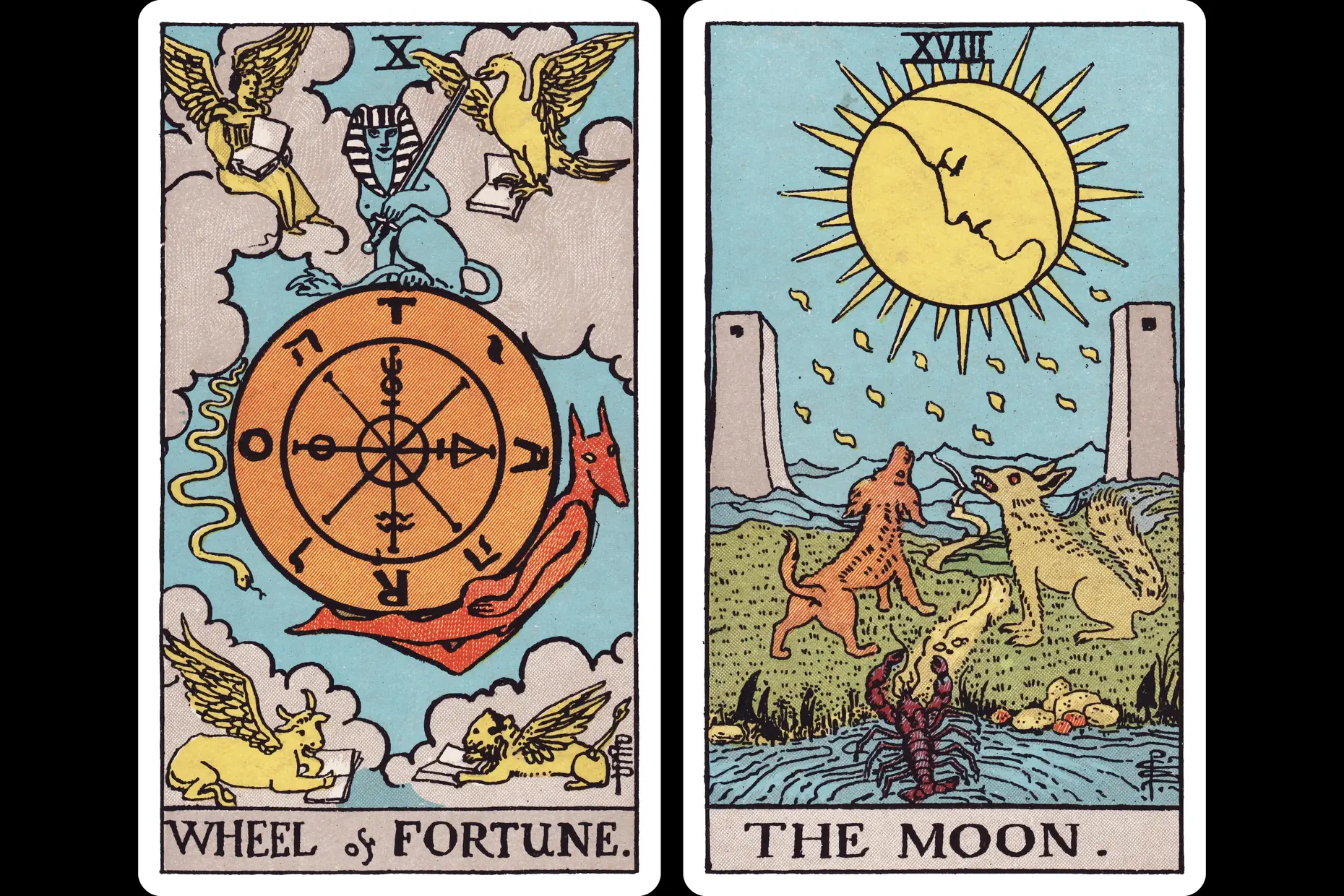
An earth-tone palette, rust, terracotta, ochre and sunset gold, pink and mauve, set against cosmic indigo, deep purple and black, with metallic gold and turquoise as accents. Cowboy, horse, and cactus silhouettes fill the lower half of the composition, with a sunset or star field above. Slab serif or dimensional rope and wood-type lettering, paired one-to-one with a named esoteric symbol, the all-seeing eye, a hamsa hand, sacred geometry, tarot-adjacent card imagery, laid over a frontier object such as a cattle skull or a horseshoe.
The American Southwest has drawn spiritual seekers since before European settlement, and alternative spiritual communities have chosen it for practice since the nineteenth century. The look has no single founding date; it was codified recently through Instagram and Pinterest circulation and festival culture such as Burning Man and Joshua Tree gatherings, then carried into wellness, retail, and tourism branding.
Wellness and retreat branding, Western lifestyle apparel, country, folk and Americana music branding, bohemian festival fashion, and Southwestern hospitality and tourism. Not for a brand that needs restraint, dense information or distance from frontier mythology.
Deserts across several world religions have long been places of spiritual encounter: wilderness where prophets receive visions, where the line between the visible and the sacred is said to thin. Indigenous traditions held the American Southwest sacred long before European settlement, and alternative spiritual communities have chosen the region for practice since the nineteenth century. The area’s vast, largely uninhabited landscape and its unobstructed night sky give the aesthetic its cosmic scale in a way that dense urban environments cannot.
The esoteric layer the style draws on is not one undifferentiated tradition. It combines Western esoteric symbols such as the eye and the hamsa hand; astrological and astronomical imagery such as moon phases, constellations, and planetary glyphs; and the broader vocabulary of contemporary wellness culture, crystals, sacred geometry, and tarot-adjacent card imagery. These are distinct sources with distinct histories, not one occult catch-all, and a designer who can name which symbol comes from which tradition is working from the actual style rather than a mood.
The aesthetic has no single founding date or named originator. It has been codified recently through Instagram and Pinterest circulation and through desert festival culture, Burning Man and Joshua Tree gatherings among them, which function as aesthetic laboratories for the look. From there it has moved into mainstream retail, Southwestern tourism marketing, residential interior design and corporate wellness programming.
| Element | What this style does | The tell |
|---|---|---|
| Colour | Grounds the palette in desert earth tones, rust, terracotta, sienna and ochre, plus sunset gold, coral pink and dusty mauve, set against cosmic indigo, deep purple and black, with metallic gold and turquoise as accents | Every composition pairs one warm, grounded colour with one cold, cosmic one; using only one half of that pairing reads as plain Western or plain celestial, not the fusion |
| Form and shape | Renders Western figures, cowboys, horses, cacti, as clean silhouettes, and celestial bodies, moons, stars, planetary glyphs, as simple graphic marks rather than realistic bodies | Figures read as flat icons set against depth, not as rendered, dimensional forms |
| Typography | Slab serifs, wood type, rope and other dimensional lettering, and hand-lettered display faces drawn from nineteenth-century Western print and signage, with a contrasting script reserved for mystical elements | Type looks carved, printed or hand-cut rather than digitally drawn; a clean geometric sans-serif breaks the style on sight |
| Layout and composition | Divides the frame between earth below and sky above, and often frames the esoteric elements in a symmetrical, mandala-like arrangement while Western action stays dynamically asymmetrical | A visible horizon line doing double duty as the boundary between the grounded half of the image and the cosmic half |
| Materials or texture | Line engraving and woodcut-style illustration drawn from nineteenth-century Western Americana printing, plus a suggestion of desert heat, shimmer and long shadow | Illustration reads as printed, not painted, even where the subject is cosmic |
| Imagery or ornament | Pairs one named esoteric symbol, the eye, a hamsa hand, sacred geometry, tarot-adjacent card imagery, a crystal or geode, with one frontier object, a skull, a horseshoe, a cattle brand | A single esoteric symbol set against a single grounded Western object; a composition covered in cactus, moon, eye and rope type together is the cliché, not the style |

| Neighbour | What it shares | What separates them |
|---|---|---|
| Gothic design | Both use the skull, the eye and mortality imagery inside decorative framing | Gothic design is dark-dominant and drawn from medieval ecclesiastical architecture or its Revival and subcultural descendants; Mystical Western is sun-warmed, earth-tone and gold, and its imagery sits inside a real, named desert landscape rather than an invented cathedral or churchyard |
| Surrealism in design | Both use the eye as a recurring symbol and reach for a dreamlike, uncanny register | Surrealism’s mechanism is the deliberate juxtaposition of unrelated real objects to unsettle the viewer; Mystical Western layers frontier and cosmic imagery on purpose to build one coherent spiritual reading of a real place, not to dislocate the viewer |
| Steampunk design | Both draw display type and illustration style from nineteenth-century Western print, wood type, rope lettering, line engraving | Steampunk invents alternate-history machinery, gears, brass, goggles, out of Victorian industry; Mystical Western has no mechanical fantasy, it turns the same print tradition toward celestial and esoteric symbolism over a real desert landscape |
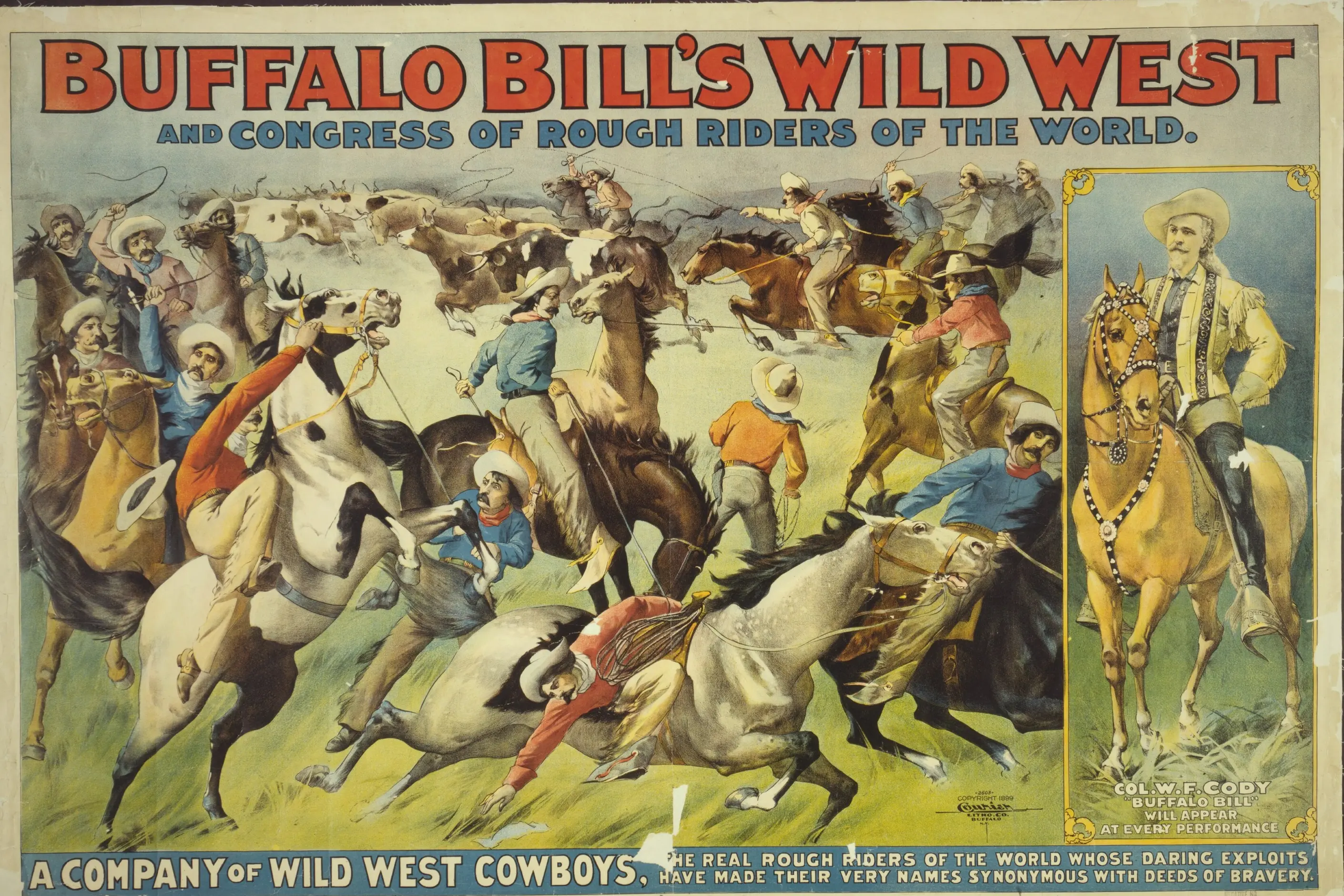
Start from the landscape, not the symbol set. You must ground the composition in specific, observed desert detail, a saguaro or mesa silhouette, an actual sunset gradient, before adding any celestial or esoteric layer, or the mysticism reads as generic and unanchored.
Choose a type from the Western print tradition. Use slab serifs, wood type, rope or other dimensional lettering, or careful hand-lettering; a clean geometric sans-serif works against the style at a glance. See Typography Basics for the underlying letterform anatomy this style elaborates rather than replaces.
Limit the esoteric vocabulary to one or two named symbols per composition. Pair a single mark- the eye, a hamsa hand, a sacred-geometry line- with a single frontier object rather than assembling cactus, moon, eye and rope type into one checklist, which is the style’s most common failure.
Build the palette from observation, not preference. Study an actual Southwestern sunset and an actual night sky, and pair a warm earth tone with a cold cosmic one in every composition.
Source Indigenous references carefully, or avoid them. Where a Southwestern Indigenous symbol, pattern or spiritual practice would be genuinely relevant, you must research it, credit it, and work with Indigenous artists directly where the practice is available for use at all. Where that is not possible, draw the esoteric layer instead from Western European esoteric tradition, general astronomical imagery or the Western print tradition itself, none of which carries that requirement.
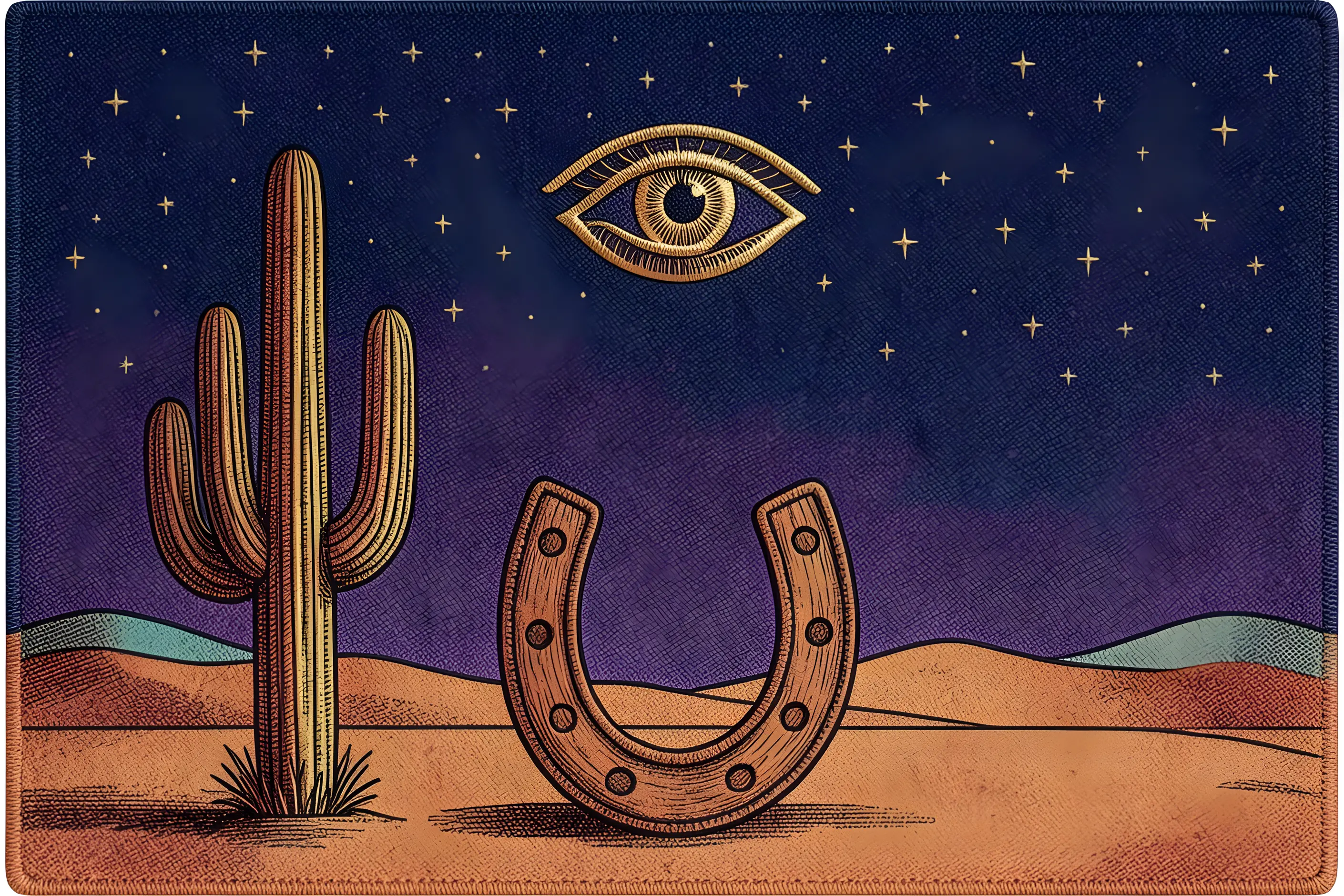
The style’s most common failure is checklist assembly: a cactus, a moon, an eye and a rope-lettered wordmark placed together with no compositional or symbolic relationship between them. The correction is synthesis, grounding the mystical layer in specific desert detail rather than treating both vocabularies as interchangeable stickers.
Two failures sit either side of that error. Esoteric imagery with no frontier grounding floats free of place and could belong to any desert culture; frontier imagery with no esoteric layer is a plain Western graphic missing the fusion the style claims to offer.
The American Southwest is an Indigenous homeland, and branding that treats it as empty or timeless wilderness erases that history. Some of the imagery the style reaches toward- specific Southwestern Indigenous patterns, motifs and spiritual practices- has an owner and a meaning that is not open for general aesthetic use, and borrowing it without research, credit, or permission is extraction rather than appreciation. Safer sourcing sits in Western European esoteric tradition, astrological and astronomical imagery, and general desert landscape, none of which requires permission.
The romantic cowboy mythology the style often assumes is also incomplete. The historical frontier included Black cowboys, Chinese railroad workers and Mexican vaqueros alongside white settlers, and a design that pictures only the last of those groups is telling a narrower story than the West’s own history supports.
What is mystical Western design? It fuses American frontier and cowboy iconography, horses, ranch culture, Western print typography, with celestial and esoteric symbolism, stars, moon phases, the eye, the hamsa hand, sacred geometry, tarot-adjacent card imagery, set against the specific geography of the American Southwest.
What makes it different from Steampunk, since both use antique-looking type? Both draw display type and illustration from the same nineteenth-century Western print tradition: wood type, rope lettering, line engraving. Steampunk turns that tradition toward invented Victorian machinery, while Mystical Western turns it toward celestial and esoteric symbolism over a real desert landscape.
Is mystical Western design at risk of cultural appropriation? Yes, when Indigenous symbols, patterns or spiritual practices from the Southwest are borrowed without research, credit or permission. Ground the esoteric layer instead in Western esoteric tradition, astronomical imagery, and the general desert landscape, and work directly with Indigenous artists where their traditions are genuinely relevant.
What is the most common mistake when designing in this style? Assembling expected elements-, cactus, moon, eye, rope, typ- without a genuine relationship between them. The correction is to limit the esoteric vocabulary to one or two named symbols, ground them in observed desert detail, and build the palette from observation rather than preference.
Which industries use mystical Western branding? Wellness and retreat brands, Western lifestyle apparel, country, folk and Americana musicians, bohemian festival fashion, and Southwestern hospitality and tourism businesses.
| Fact | Detail |
|---|---|
| Origin | No single founding date or named designer; American Southwest spiritual seeking traces to the nineteenth century, the aesthetic itself codified recently through festival and social media culture |
| Core fusion | American frontier and cowboy iconography, celestial and cosmic imagery, and Western esoteric symbolism, set in the specific geography of the American Southwest |
| Named locations | Monument Valley and the Colorado Plateau, mesa and butte geology; Burning Man and Joshua Tree gatherings, festival culture |
| Primary channels | Instagram and Pinterest circulation, desert and music festival merchandise |
| Named esoteric symbols | The all-seeing eye, the hamsa hand, sacred geometry and mandala forms, tarot-adjacent card imagery |
| Primary application | Wellness and retreat branding, Western lifestyle apparel, country, folk and Americana music branding, bohemian festival fashion, Southwestern hospitality and tourism |
