

2026-09-15
Nural Choudhury
The Arts and Crafts movement is a design and social reform movement that began in Britain in the second half of the nineteenth century, built around dense botanical patterns, honest materials and visible handcraft, as a direct reaction against industrial factory production.
Its neighbour, Art Nouveau, borrowed its organic vocabulary but dropped the politics: Arts and Crafts critiques how things are made and by whom, not just a look drawn from plants.
dense, flattened botanical repeat patterns (leaves, birds, vines); an earthy palette of indigo, madder red, sage green and cream from vegetable dyes; heavy, hand-lettered type crowded onto the page with almost no white space; visible joinery in furniture, exposed pegs and through-tenons treated as ornament, not hidden.
Britain, 1860s to the 1900s, growing out of John Ruskin’s critique of industrial labour and put into practice by William Morris and the guild movement, then carried to America by Gustav Stickley and the Greene brothers.
any brand or object that needs to read as handmade, ethically produced or artisanal: craft goods, sustainable packaging, small-batch food and drink, anything trading on authenticity over polish.
The critique came before the style. John Ruskin argued in “The Stones of Venice” (1851 to 1853) that hand-carved medieval ornament revealed the freedom of the worker who made it, while identical machine-stamped ornament revealed only mechanical repetition. For Ruskin, this was a moral failure as much as an aesthetic one: a system organised around industrial efficiency degraded the worker regardless of output.
William Morris, who encountered Ruskin’s ideas as an Oxford student, put them into practice. He worked as a designer, poet, printer and eventually socialist activist, learning weaving, dyeing and printing himself rather than directing artisans from a distance. He founded Morris, Marshall, Faulkner & Company, later Morris & Company, and the Kelmscott Press, producing wallpapers, textiles, furniture and books as integrated works of design. His patterns, among them “Strawberry Thief” and “Willow Boughs,” remain the movement’s most recognisable images.
The movement organised into guilds and societies, including the Century Guild and the Art Workers’ Guild, with architects such as Philip Webb designing buildings that expressed structure and material honestly. It crossed the Atlantic through Gustav Stickley’s Craftsman furniture and his magazine “The Craftsman.” It found distinctive form in California through Charles and Henry Greene, whose Gamble House (1908) in Pasadena fused Arts and Crafts principles with Japanese influence. In continental Europe, the same concerns fed into the Wiener Werkstätte in Vienna and German design reform circles, and influenced the early Bauhaus. However, those later movements moved toward the industrial production Morris had set out to critique.
The movement carried an unresolved contradiction. Morris wanted well-made objects available to everyone, but the handcraft methods he championed made them expensive and sold them mainly to the wealthy customers he distrusted. He admitted as much: he described himself as “ministering to the swinish luxury of the rich,” and he responded by becoming a socialist, arguing that design reform alone could not deliver the good life without economic reform alongside it.

| Element | What this style does | The tell |
|---|---|---|
| Form and pattern | Flattens observed botanical growth into repeating two-dimensional units | Dense, interlocking plant and bird motifs that fill the surface, never isolated on empty ground |
| Colour | Uses vegetable-dye palettes that Morris personally revived | Muted indigo, madder red, weld yellow, sage green and cream, none of them synthetic-bright |
| Typography | Treats type as part of a unified page composition, drawn from medieval manuscripts | Heavy, near-Gothic letterforms, minimal white space, ornamental initials integrated with the text block |
| Materials and construction | Expresses material and joinery honestly rather than disguising them | Exposed tenons, pegs and through-bolts on furniture, treated as decoration rather than hidden |
| Ornament | Grows from the structure of the object rather than being applied afterwards | Decoration that cannot be removed without changing the object’s logic, not a border stuck on a blank form |

| Neighbour | What it shares | What separates them |
|---|---|---|
| Art Nouveau | Organic, plant-derived line and pattern, roughly overlapping decades | Art Nouveau is a whiplash-curved, often asymmetric commercial style aimed at luxury markets; Arts and Crafts is a labour critique first, expressed through flattened, repeating pattern rather than sinuous line |
| Victorian design | Same nineteenth-century Britain, sometimes the same drawing rooms | Victorian design is eclectic accumulation, historical styles stacked with no unifying logic; Arts and Crafts is a deliberate reaction against exactly that industrial ornament and stylistic magpie habit |
| Shabby chic | Both read as handmade, aged and non-industrial | Shabby chic is a deliberately distressed finish applied to furniture after the fact; Arts and Crafts honesty is structural, visible joinery and undisguised material, not a worn-in surface effect |
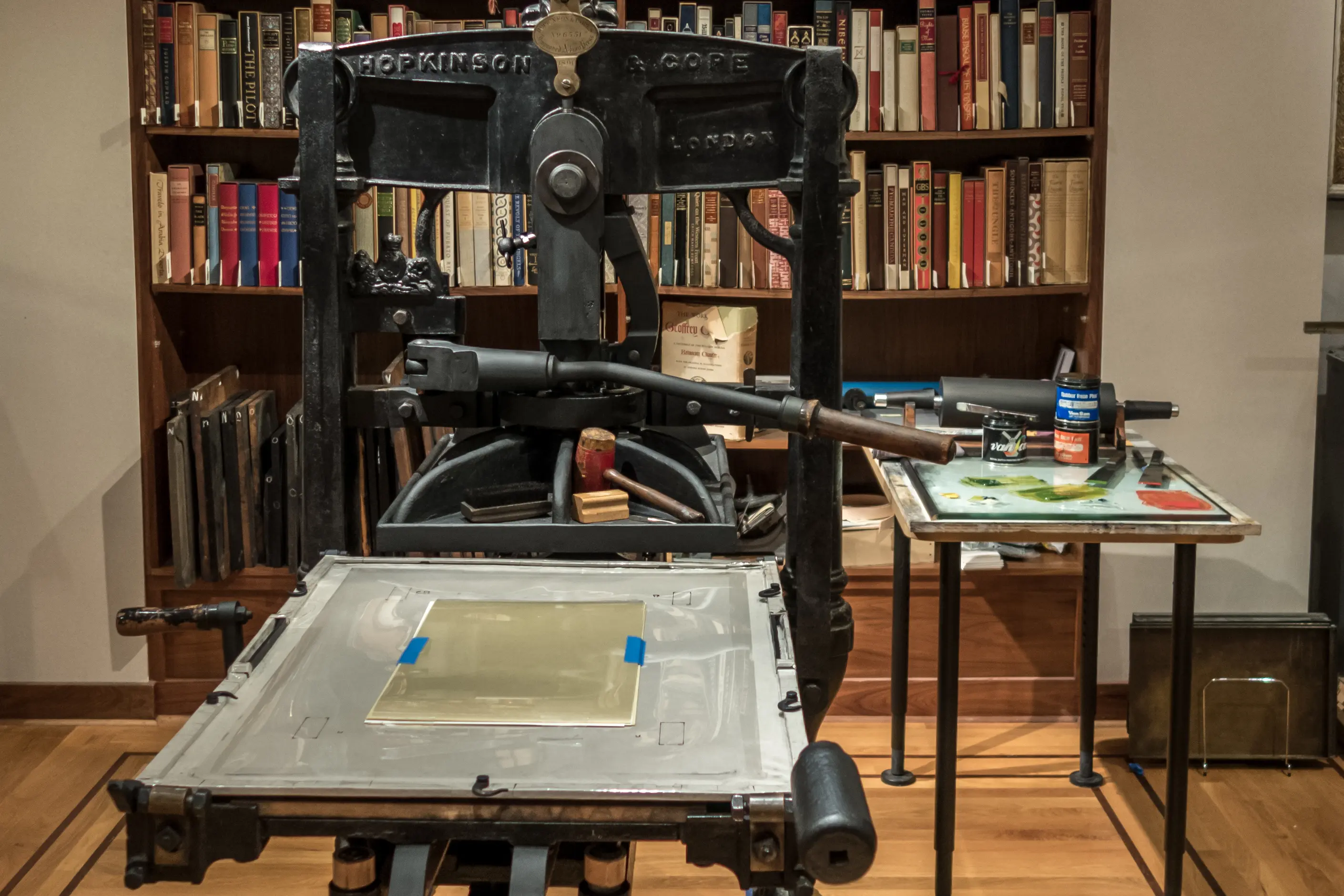
Start from material honesty. Let wood show its grain, let joinery show its structure, and treat the visible seam as an opportunity rather than a flaw to hide.
Build ornament from the object’s own logic before you add it. A pattern that could be peeled off without changing anything about the design has failed the movement’s central test.
Choose an earthy, muted palette drawn from natural dye sources rather than saturated digital colour, and let type sit dense on the page rather than floating in generous white space.
Name the risk plainly: reach for this only when authenticity and craft genuinely serve the brief. Applying botanical wallpaper texture to a sleek, mass-produced product is pastiche, and the movement’s own history makes that contradiction visible rather than invisible.
Contemporary contexts that reach for this style tend to cluster around three claims: the maker movement’s small-batch, hand-lettered goods; sustainability arguments for durability over disposability and repair over replacement; and the Scandinavian idea of hygge, cosy, natural-material domestic comfort that overlaps with Arts and Crafts’ own vision of the home as sanctuary. Use these to check intent. If a brief genuinely wants one of those three claims, the style is doing honest work; if it only wants the surface pattern, say so before you start.
The style collapses into decorative wallpaper cliché when designers borrow the botanical surface pattern and drop the labour politics that gave it meaning. A brand using Arts and Crafts visual language while manufacturing under exploitative conditions isn’t referencing the movement; it is contradicting it.
The movement never solved its own founding paradox. Handcrafted, ethically produced goods cost more than mass production, so the people Morris wanted to liberate from industrial labour could rarely afford what liberated labour produced. That tension persists in every contemporary maker and sustainable-design context that borrows the aesthetic without reckoning with the economics.
It also does not carry dense information well. The crowded, ornament-filled surface that reads as rich and handmade in a wallpaper or a book page becomes noise on an interface that needs to communicate data clearly.
It also flattens easily into “digital authenticity” theatre: a software filter simulating hand-lettering or a generated pattern simulating botanical observation borrows the look while erasing the actual claim that a person made this thing by hand.
Is Arts and Crafts the same as cottagecore or farmhouse style? No. Farmhouse and cottagecore aesthetics borrow its warmth and natural materials for a contemporary domestic mood. Still, they are internet-era aesthetics without the movement’s labour critique or its documented guild history.
Why does the movement matter if its economics never worked? Because the questions it raised- whether design serves human flourishing or commercial efficiency, and whether the process of making matters as much as the object- remain open, and its vocabulary is still the clearest way to argue for durability and honest labour over disposability.
Did Arts and Crafts lead to the Bauhaus? Indirectly. Arts and Crafts workshop pedagogy and concern with design quality influenced the early Bauhaus, but the Bauhaus moved toward industrial production and geometric reduction that Morris had explicitly criticised.
What is “truth to materials” in practice? Morris’s term for expressing a material’s real properties rather than disguising them: wood showing grain, metal showing hammer marks, joinery left visible as ornament rather than concealed.
| Fact | Detail |
|---|---|
| Origin | Britain, second half of the nineteenth century |
| Key critic | John Ruskin, “The Stones of Venice,” 1851 to 1853 |
| Central figure | William Morris, founder of Morris, Marshall, Faulkner & Company and the Kelmscott Press |
| Defining patterns | “Strawberry Thief,” “Willow Boughs” |
| American furniture maker | Gustav Stickley, Craftsman furniture, magazine “The Craftsman,” 1901 to 1916 |
| American architecture | Charles and Henry Greene, Gamble House, Pasadena, 1908 |
| Organising bodies | Century Guild, Art Workers’ Guild, Arts and Crafts Exhibition Society |
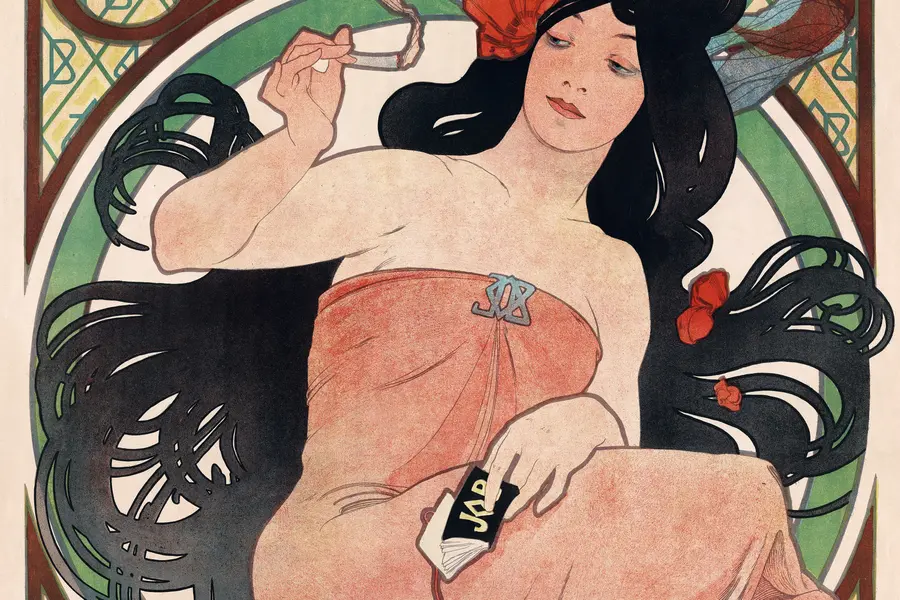
Art Nouveau is an international decorative style that ran from roughly 1890 to 1910, replacing the borrowed ornament of historical revivals with a single vocabulary drawn from plant growth, insect wings and the female form.
Read it
Victorian design is the ornate, eclectic visual culture of Britain and its export markets during Queen Victoria’s reign, 1837 to 1901, when steam-powered printing and chromolithography made heavy ornament affordable to a middle class that had never been able to buy it before.
Read it
Gothic design is the pointed-arch, vertically emphasised architecture, manuscript illumination and decorative art of Latin Christian Europe, built from the 1140s to the early sixteenth century around stained glass, tracery, and dramatic light.
Read it
Scandinavian design is a modernist design philosophy that developed across Denmark, Sweden, Norway, Finland, and Iceland from the early twentieth century, based on the idea that good design is a public good, not a private luxury.
Read it
Minimalism in design reduces a composition to the elements it cannot function without, so colour, form, type, and space each carry more weight because there is less to look at.
Read it
Farmhouse is an interior style with roots in real agricultural buildings: pre-industrial rural houses and working farm structures, revived for contemporary homes since the early 2010s.
Read it
Shabby chic is an interior and graphic design aesthetic built on distressed paintwork, faded pastel colour and accumulated vintage objects, popularised by British designer Rachel Ashwell from the late 1980s.
Read it
The Bauhaus is a German school of art, craft and design that operated from 1919 to 1933.
Read it