
2026-09-15
Nural Choudhury
A headcount request fails when it arrives as a request, and survives when it arrives as a business case with a cost attached to saying no.
Your manager does not owe you belief in your team’s workload. They owe their own manager a decision they can defend, so the burden of proof sits with you.
A headcount conversation stuck on your manager’s gut sense that the team seems busy, or the same request asked and declined every quarter, with neither side able to say why.
Put a documented cost of not hiring next to a costed, specific role in front of whoever owns the budget, and get back either a fundable decision or a named condition for revisiting it.
A workload audit, a written cost of inaction, a role specification with a start date for accountability, and a committed business outcome the hire is tied to.
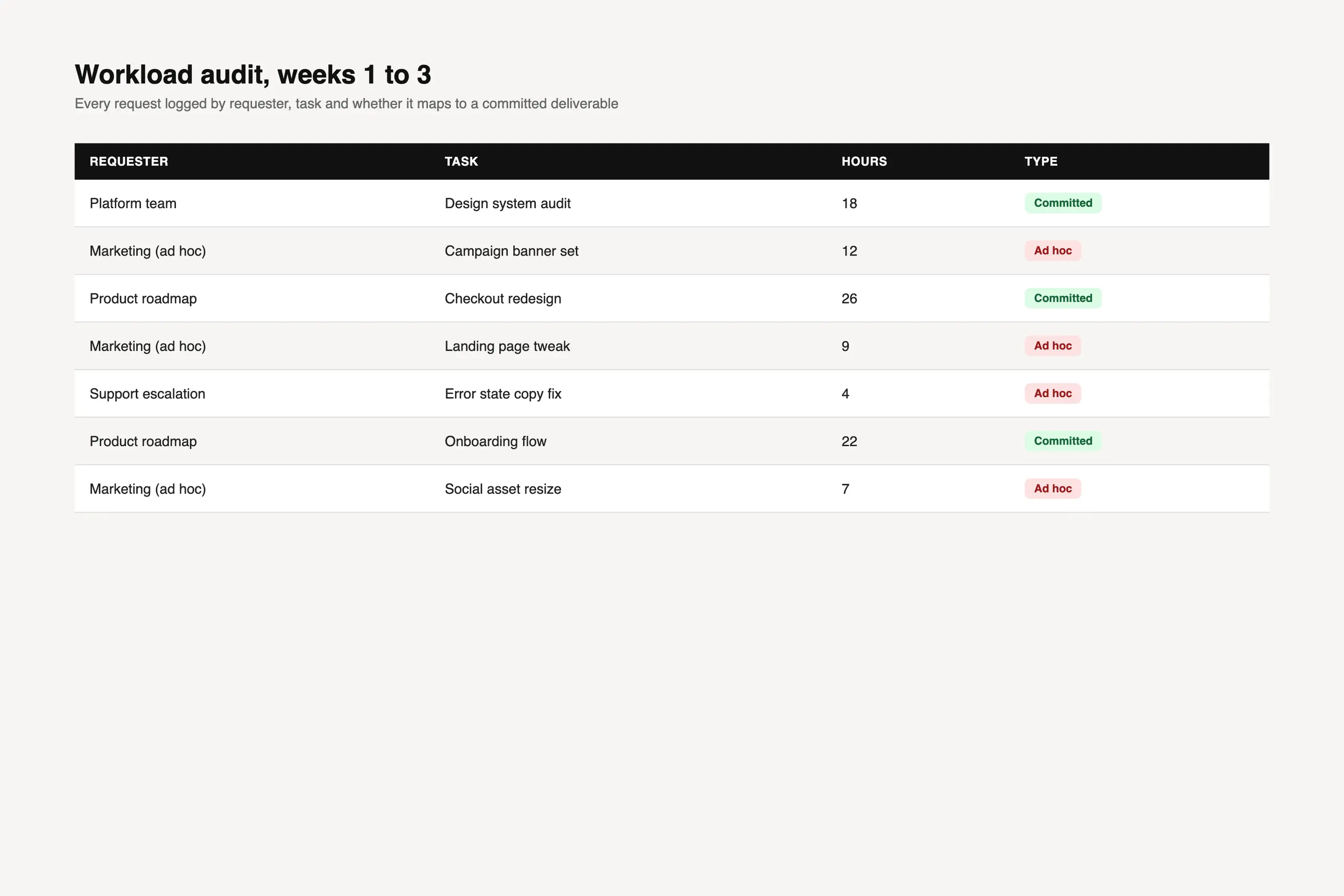
Start with an audit, not an impression. Log what your team does for two to four weeks: every request, where it came from, and whether it maps to a committed deliverable or arrived ad hoc. Skip the question of how busy people feel and ask instead what they worked on and where the time went.
Break the audit down by requester as well as by task. A single stakeholder generating a disproportionate share of ad hoc work is a different problem from a genuinely overloaded team, and a business case that conflates the two invites the wrong question in the room: why has nobody managed that stakeholder instead of hiring around them.
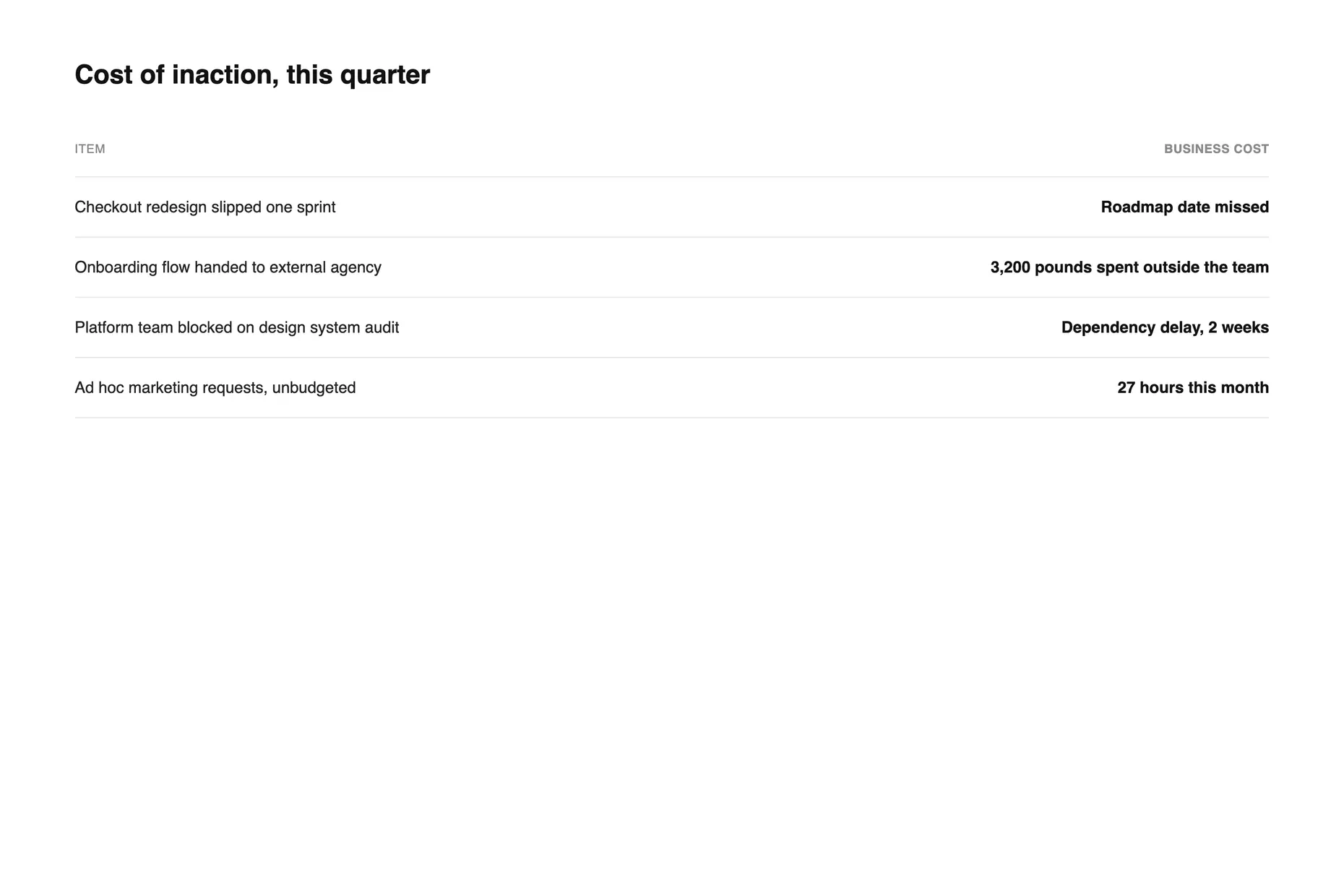
Turn the audit into a cost, not a complaint. For every delay the audit surfaces, name what it cost the business: a missed roadmap date, a dependency another team was waiting on, or work sent to a contractor or agency instead of built in-house. A senior manager can act on a missed date, not on “the team is stretched”.
Where you have no hard figure, say so and describe the direction of travel instead of guessing one. A named gap you are still closing carries more weight than a number nobody can defend under questioning, and it is far easier to recover from than being caught with an invented one.
Specify the role before you ask for it: a job title, a seniority level, and what moves onto their desk on day one. Take the pay band to whoever owns compensation in your organisation and use their figure. Never present your own guess as a number finance can hold you to.
Name who the role reports to and who it works with day to day. A senior manager reading a specification with no reporting line and no named collaborators reasonably assumes you have not thought past getting the yes. That assumption costs you more than the missing detail itself.
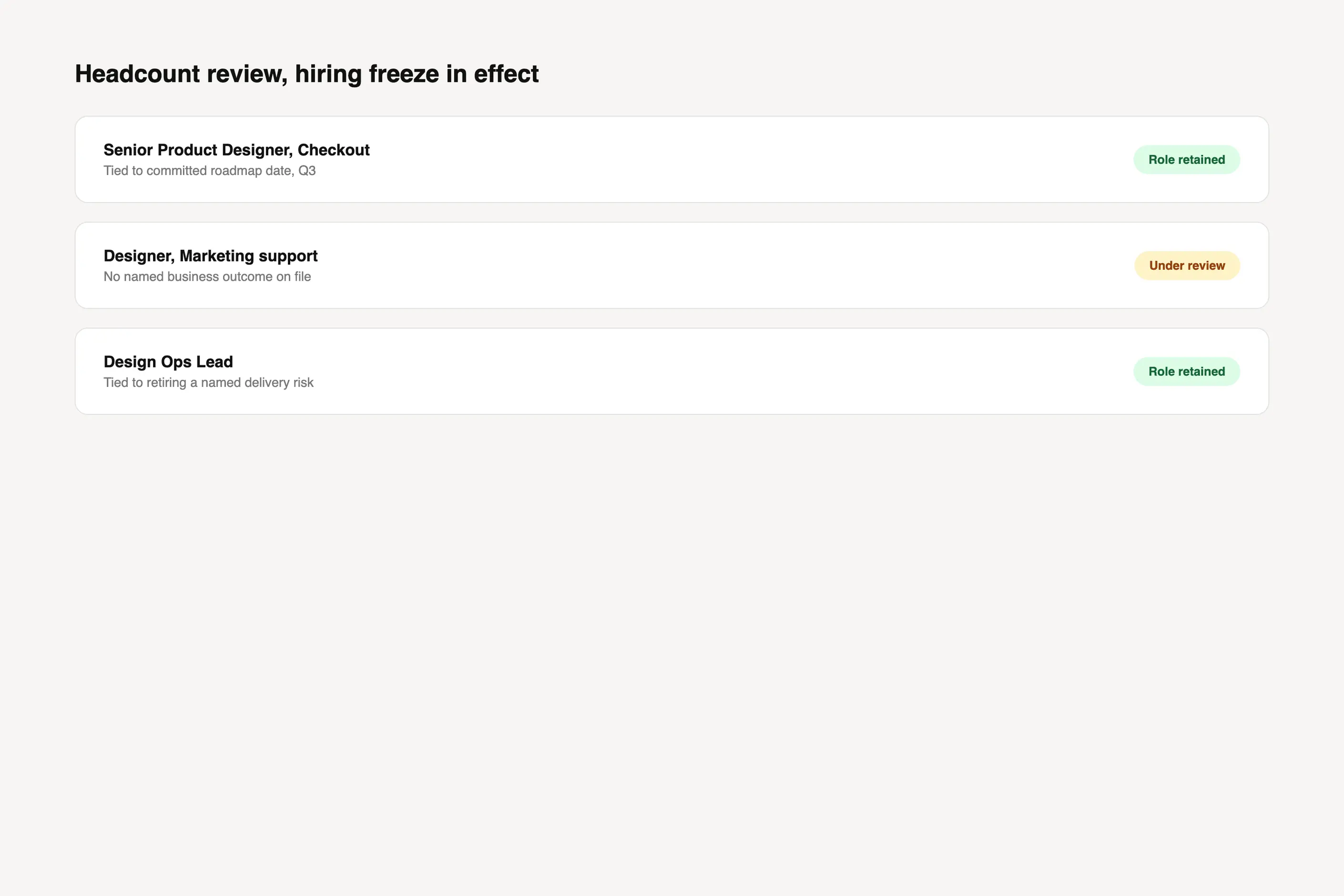
Name a business outcome the extra capacity buys: a date you can then commit to, a queue you can close, a risk you can retire. A hire justified by relief buys goodwill for one quarter and nothing after it. A hire tied to an outcome buys a reason to keep the role when budgets tighten.
Take the case to someone outside your own reporting line, in finance or operations if you can reach them, and ask them to attack it. You must be able to answer why this cannot go to an existing team member, and why it can’t go to a contractor, before your manager asks.
Present the case, then define what you will accept if the answer is not an outright yes. A conditional no, with the condition stated, means the business case is working. A silent no is one going nowhere.
I hand over the structure: audit, cost, role specification, committed outcome. I keep the sign-off and any part of the case that touches a headcount decision I don’t own, because that conversation belongs to me, not the person asking.
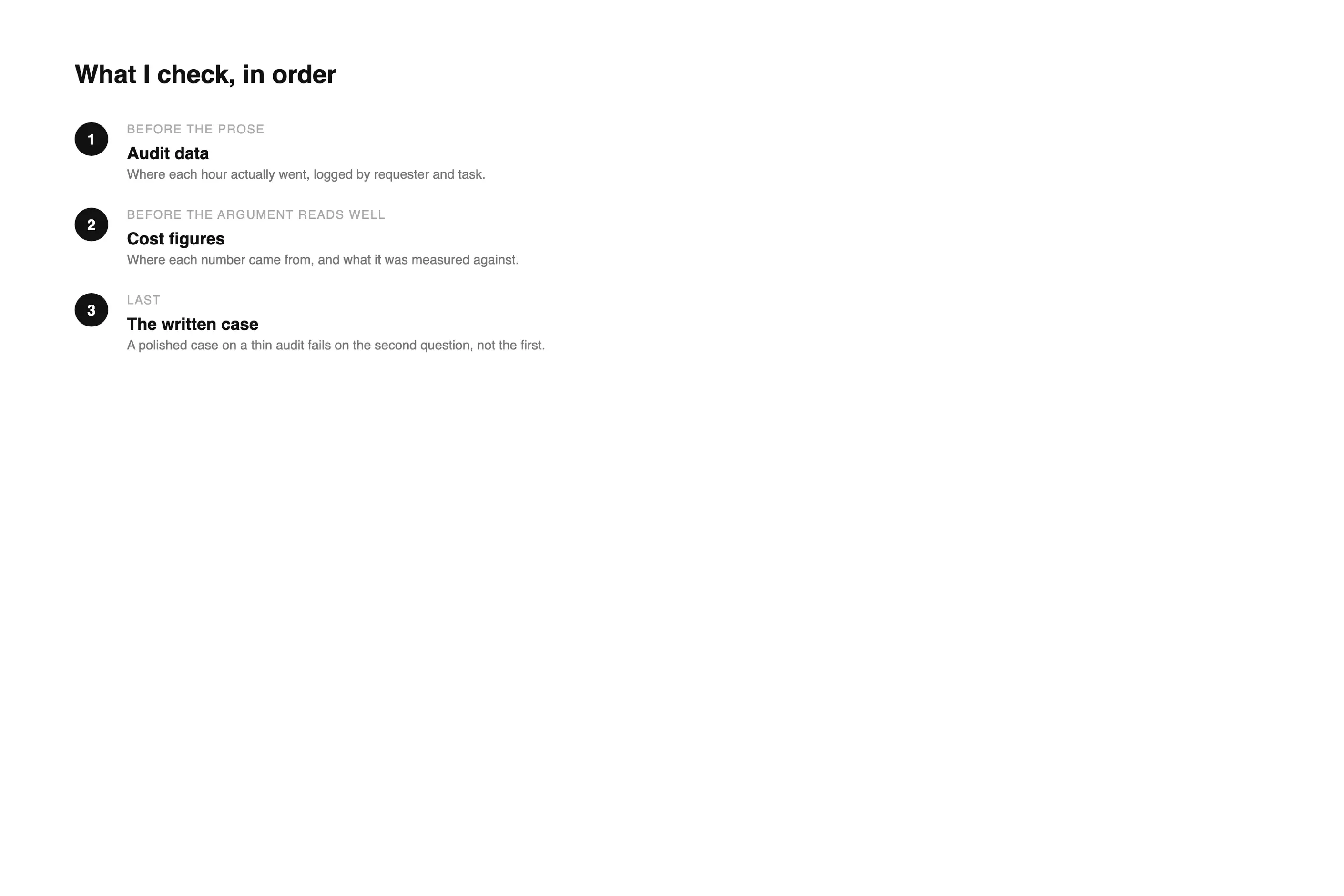
What I check is not the writing. I want to see the audit data before I see the prose built on it, and I ask where each cost figure came from before I ask whether the argument reads well. A polished case built on a thin audit is worse than a rough one built on a solid audit, because a thin polished case survives a first read and fails on the second question.
The conversation that goes wrong is when a senior designer presents their own team’s exhaustion as the case. “We are all so busy” is a feeling, and feelings get overruled by other feelings. The question that fixes it is what the business loses if this doesn’t happen, and an answer that only points back at their own team means the case isn’t ready to leave the room.
How I know they have got it: they build the next case without bringing me the audit first, and they can defend the numbers under cross-questioning from someone with no reason to be generous. At that point I am reading the case for the first time alongside whoever they are presenting it to, not before, and that is the point at which I stop checking.
I have seen a team ask for another designer when the real issue was that nobody had said no to a backlog that kept growing. Hire into that, nd the new person inherits the same unmanaged queue within a quarter. The audit exists to catch this before the case is written, not after the hire arrives and the same complaints return with one more person to absorb them.
A tired team is a real problem, and it is not a business case. Senior management, correctly, treats “we are struggling” as a management issue for you to solve, not a budget line for them to fund, unless it is translated into something the business loses. Strain is the reason you go looking for the audit, never the evidence itself.
A hire justified by workload relief has nothing to point to when a freeze memo goes around, and every open role is reviewed against committed output. A hire tied to a named business outcome survives that review, because someone else in the room, whoever owns that outcome, can vouch for what the role was buying before anyone reaches your desk.
How long should building a case like this take:
Long enough to run a real audit, which is two to four weeks, plus the time to get one honest outside review. Rushing the audit is the most common way a case arrives full of impressions dressed up as evidence.
What if my manager says no:
Ask what would change the answer: a different budget cycle, a different outcome named, a different role level. A no with no condition attached is not a decision; it is a deferral, so treat it as unfinished business, not a result.
Should I show the audit to my team before I present the case:
Show them the findings, not the pitch. They will recognise their own workload in the audit, and a team member spotting a gap before your manager does is worth more than a tidy first draft.
What if finance asks for a number I do not have:
Say so, then go and get it from whoever owns that data. A guessed number that turns out wrong costs you more credibility than an honest gap you close within the week.
Do I need HR involved before I take this upward:
Involve whoever owns the role specification and the pay band in your organisation before you present, not after. Presenting a role nobody has costed invites the meeting to end on a question you cannot answer.
| Fact | Detail |
|---|---|
| Core artefact | A written business case, not a verbal request for more people |
| Minimum components | A workload audit, a documented cost of inaction, a role specification, and a committed business outcome the hire is tied to |
| Source of pay data | Whoever owns compensation data in your organisation, never the requester’s own estimate |
| Where the case is tested | Before it reaches senior management, against someone in finance or operations with no reason to agree |
| What a hiring freeze reviews against | Committed business outcomes, not team workload |
| Most common failure | A case built on team strain instead of a costed business outcome |

Task analysis is the systematic study of how people currently perform a task, breaking it down into the steps, decisions and knowledge each one requires.
Read it
Data analysis for design is the practice of testing decisions against measured evidence, usage data, and controlled experiments, rather than defending them by opinion alone.
Read it
Choosing a product metric is a design decision, not an analytics task, because the metric you pick decides the behaviour a team produces.
Read it
A team isn’t misaligned because it lacks a vision; it is misaligned because the cadence that surfaces disagreement before it hardens doesn’t exist.
Read it