

2026-09-15
Nural Choudhury
Generative design systems set parameters, constraints, and goals, then let an algorithm search the space of possible solutions instead of drawing one outcome by hand.
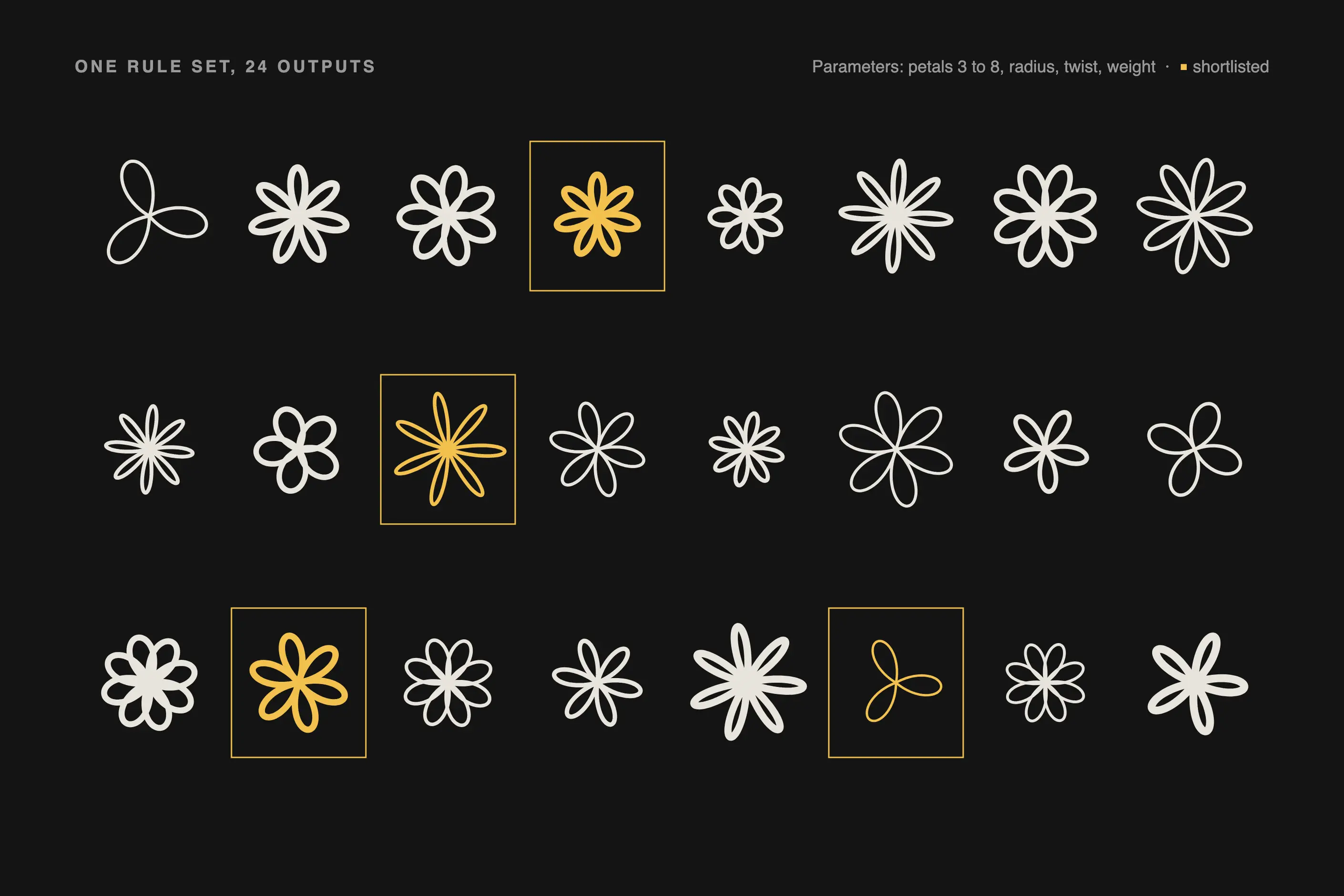
The designer’s authorship moves from the artefact to the system that produces it: the rules are the design work, and any single output is one instance among many the system could have generated. This is what separates the practice from AI-generated aesthetics, where a person prompts a model trained on someone else’s images and supplies curation rather than an authored rule set.
A family of many related outputs, ranked or filtered against a stated goal, rather than one finished artefact. Forms that follow structural load, environmental data, or a manufacturing constraint instead of a hand-drawn line, often reading as organic because material sits only where the goal needs it. Type, colour or pattern that shifts along a defined axis (a variable font, a data-mapped gradient, a procedural texture) instead of switching between fixed choices.
Computational design research through the late twentieth century, formalised in architecture and engineering through tools such as Grasshopper and Autodesk’s generative tools, and extended into graphic and product design as machine learning matured.
Structural optimisation, mass customisation, facade and layout systems, identity systems that must vary by context while staying recognisable, and any problem with more candidate solutions than a person could evaluate by hand.
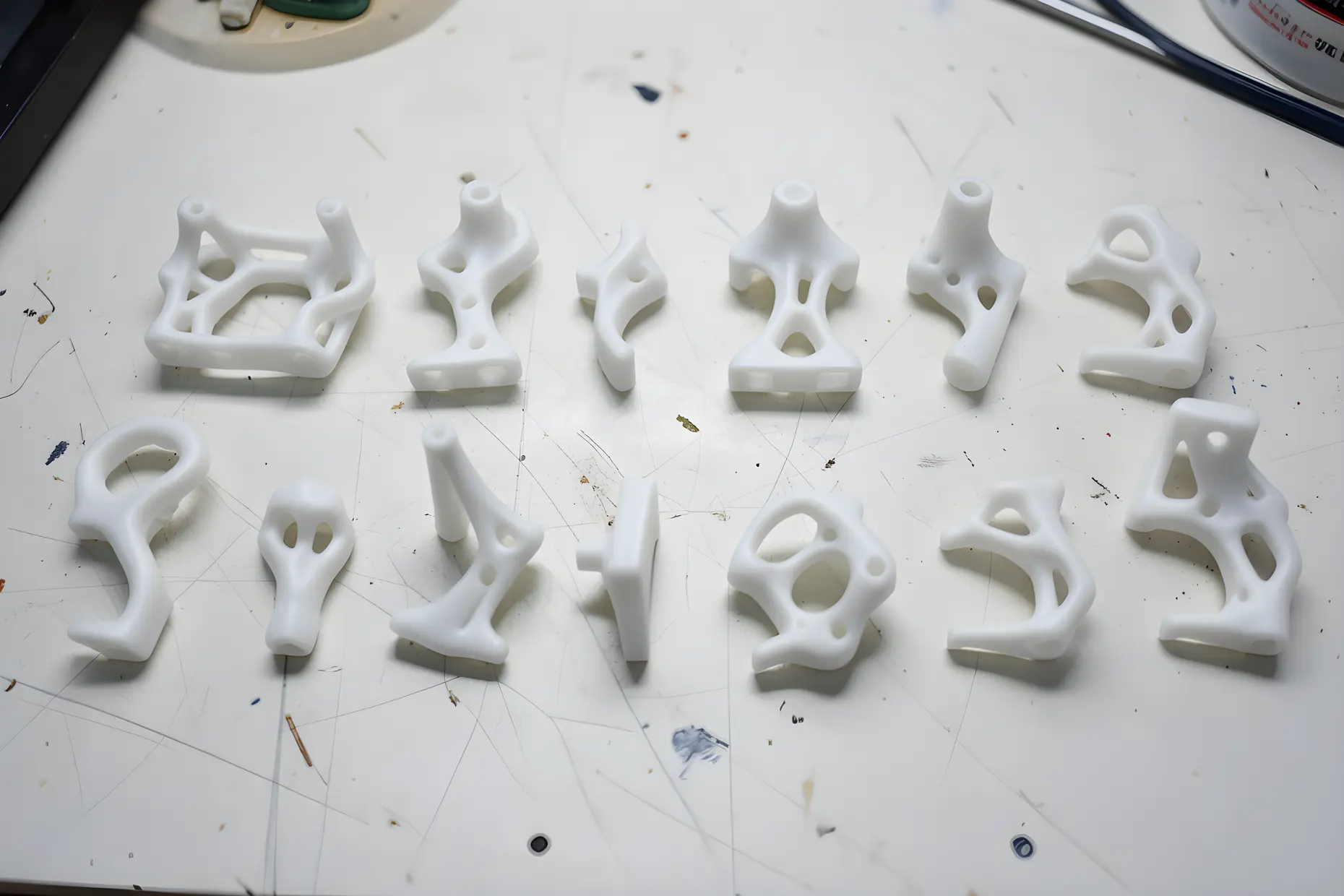
Generative design systems grew out of computational design research through the late twentieth century, when architecture and engineering practices began encoding design logic as rule systems and running them on increasingly capable machines. Topology optimisation, the technique of removing material where structural stress is low and keeping it where stress is high, became an early proving ground. Airbus applied it to a cabin partition and reported a 40 per cent weight reduction, and General Motors used the same approach to redesign seat brackets.
Grasshopper, released for Rhino, carried the method from research contexts into everyday architectural practice, and Autodesk later added generative tools in Fusion 360, nTopology, and Siemens NX for engineering-scale work. Advances in machine learning through the twenty-first century extended generative methods beyond structural engineering. MIT Media Lab built a parametric logo that could vary systematically while remaining recognisable, an early example of a generative identity system, and the underlying idea- a system that produces a family of outputs from defined parameters- now runs across architectural facades, interface components, industrial manufacturing, and brand identity systems.
| Element | What this style does | The tell |
|---|---|---|
| Form and shape | Removes material from a structural form where stress is low and keeps it where stress is high, or lets a facade or component follow an environmental or functional variable. | Organic, load-following forms that look grown rather than drawn, with no arbitrary curve or corner. |
| Materials and texture | Distributes material density, lattice structure or surface finish according to a stated parameter (load, weight target, fabrication method) rather than applying it uniformly. | Material sits exactly where the goal needs it and nowhere else; procedural textures and patterns carry a family likeness without repeating. |
| Typography | Uses variable font systems and algorithmic letterform exploration so a typeface shifts weight, width or slant along a defined axis instead of switching between fixed styles. | Type that behaves like a parameter rather than a swatch: it slides rather than swaps. |
| Layout and composition | Arranges elements through content-aware or rule-based logic, or generates identity systems that hold a mark constant while letting it vary by context. | A layout, pattern or mark that stays recognisably one system across many instances, with no two examples identical. |
| Colour | Maps hue, saturation or value to a variable (spatial position, structural load, a data value) instead of choosing a palette by eye. | Colour that reads as an encoded variable, a gradient or systematic shift you can trace back to the number driving it. |
| Output and process | Produces a ranked or filtered family of dozens, hundreds or thousands of candidate outputs from one set of parameters, rather than a single finished piece. | You are looking at one instance selected from a visible population of near-siblings, not a one-off. |
| Neighbour | What they share | What separates them |
|---|---|---|
| Parametric design | Both are rule and constraint driven, produce coherent families of variation, and move design labour into defining the system rather than drawing the artefact. | Parametric design is generative design’s most legible technique: a person defines explicit relationships between named parameters and directly navigates the resulting space. Generative design systems is the broader category: it adds evolutionary search, gradient optimisation and neural generation as further exploration methods, and it reaches beyond architecture and product into identity systems, layout and personalisation. |
| AI-generated aesthetics | Both produce far more output than a person could make by hand and depend on human curation to turn candidates into finished work. | A generative designer authors the parameters, constraints, and goals that generate the work; an AI workflow queries a model trained on someone else’s images and contributes a prompt and curation rather than an authored rule set. Generative parameters map to a stated design value, such as load or cost; a prompt maps to whatever the training data happened to contain. |
| Biomimetic patterns | Both can produce organic, grown-looking forms, and topology optimisation arrives at forms that echo the stress-following logic of bone and branch. | Biomimetic patterns start from a natural form or mechanism and imitate or adapt it deliberately. Generative design systems start from a stated goal and constraint set; an organic result is often an emergent consequence of optimisation rather than a reference to any organism. |
Define your parameters before you generate anything. Decide what the system can vary (dimensions, colours, materials and arrangement) and connect every parameter to a real constraint: structural, brand, cost, or fabrication. A parameter that answers no real design question is not worth encoding.
Set ranges that are wide enough to surprise you and narrow enough to stay usable. A range so tight the system cannot discover anything different from what you would draw by hand wastes the method, and a range so wide the outputs scatter without coherence wastes your evaluation time instead.
Treat constraints as boundaries, not blueprints. Leave room for the system to discover a solution you did not specify, because over-constraining a generative system removes the reason to use one. Build a genuine curation phase into your process and budget real time for it: raw algorithmic output is a starting point, not a deliverable.
State your goals explicitly and say plainly what you are trading off. Multiple objectives (strength against weight, cost against quality) compete with each other, and you must decide the weighting, or let the system present the trade-off surface and choose from it, before calling one output better than another.
Watch for pastiche. A form borrowed because it signals computational sophistication, without a constraint architecture behind it, is decoration wearing the method’s clothes rather than the method itself.
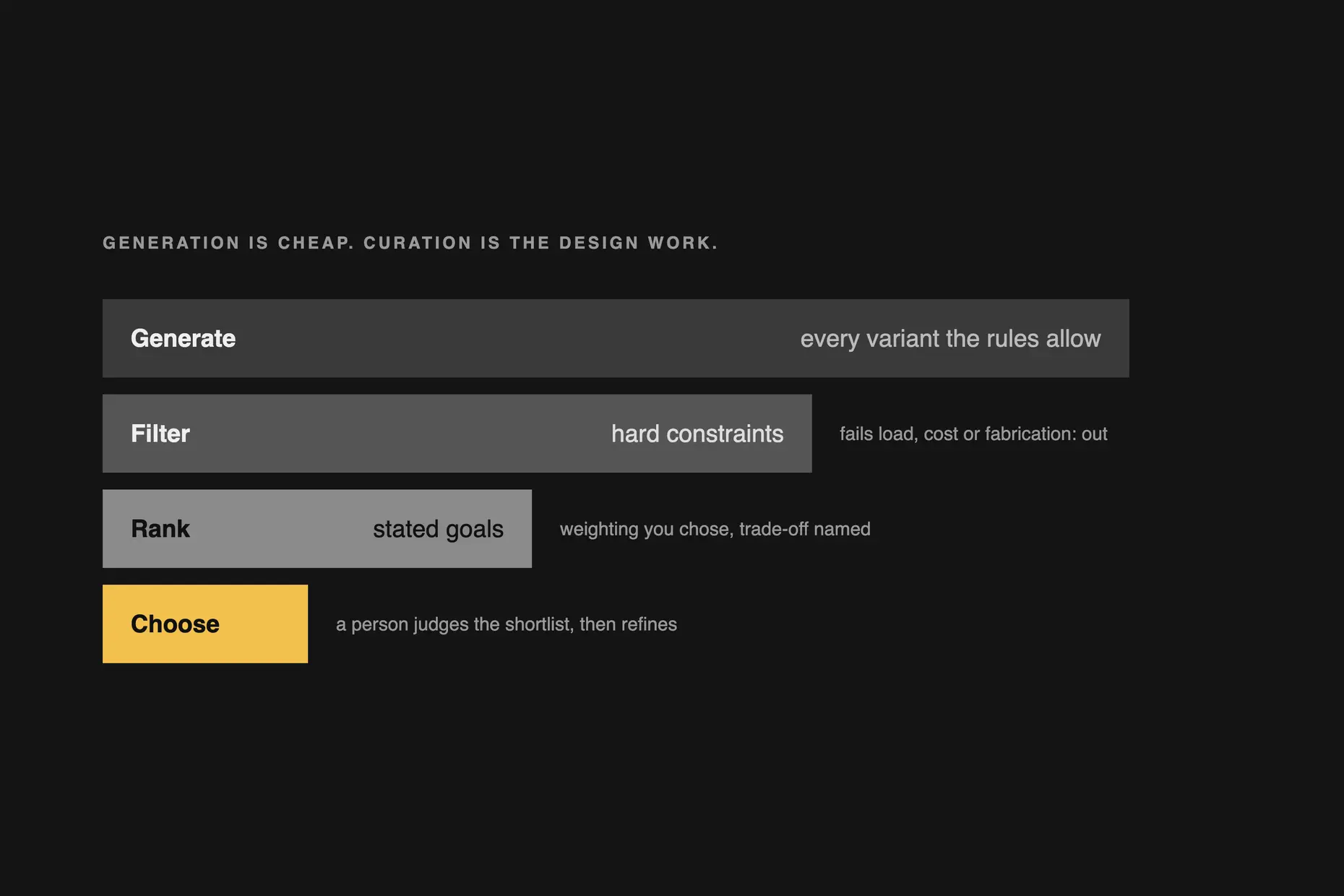
Uncurated output is the most common failure. Presenting raw algorithmic results without evaluation and refinement is not finished design; it substitutes generation for the judgement that makes generation useful, and it happens most often under time pressure or where curation skill lags behind the fascination with generating in the first place.
Computational cliché is the visual failure that follows. Organic blobs, Voronoi patterns and visible topology optimisation have become the aesthetic signature of the tools rather than a considered choice, and a form selected because it looks generated is no better reasoned than a form selected because it looks handmade.
Process worship substitutes a good story for a good result. A fascinating generative process that produces a mediocre outcome is still a mediocre outcome, and the honest test is whether the design would hold up if a person had made it by hand, not whether the method behind it was interesting to describe.
The gap all three leave behind is a missing human touch: output that is technically correct against the stated goals but empty of the qualities no goal captured. Warmth, personality and judgement about what matters do not appear in an objective function, and only a curator supplies them.
No. A generative designer authors the parameters, constraints, and goals a system obeys, and the system’s logic is visible and adjustable. An AI image tool queries a pre-trained model built on someone else’s data, and the designer’s main lever is the prompt rather than an authored rule set.
Does using machine learning inside a generative system make it AI-generated aesthetics? Not necessarily. Neural network generation is one of several exploration methods a generative system can use alongside evolutionary algorithms, gradient descent, and rule-based logic, and the designer still defines the parameters, constraints, and goals. AI-generated aesthetics names a narrower, prompt-driven practice built on a pre-trained model the designer did not construct.
How many parameters should a generative system have? As few as needed to answer a real design question and no more. Every parameter should trace back to a structural, brand, cost, or fabrication requirement; parameters added because the software allows them, rather than because the problem needs them, produce complexity without benefit.
No. It replaces manual exploration and execution at scale, but someone still has to define what better means, set the goals the system optimises toward, and select from what it returns. Curation is design work, not a formality performed after the real work is finished.
What is the most common mistake in generative practice? Presenting raw output without curation. A system that explores thousands of candidates has done half the job; refining, combining and rejecting what it returns is the other half, and skipping it is the single most visible sign of an uncurated generative process.
| Fact | Detail |
|---|---|
| Origins | Computational design research through the late twentieth century, accelerated by machine learning in the twenty-first |
| Early proving ground | Topology optimisation in structural and industrial engineering |
| Named examples | Airbus cabin partition, 40 per cent weight reduction; General Motors seat brackets; MIT Media Lab’s parametric logo |
| Industrial and engineering tools | Autodesk’s generative tools in Fusion 360, nTopology, Siemens NX |
| Architecture and 3D tools | Grasshopper for Rhino, Houdini, Dynamo for Revit |
| Digital and graphic tools | Adobe Firefly, Figma’s generative plugin ecosystem, Processing and p5.js, RunwayML |
| Generation methods | Random sampling, grid sampling, evolutionary algorithms, gradient descent, neural network generation, and rule-based systems |
| Domains | Architecture, industrial and product design, graphic and digital design, and data-driven personalisation |
Parametric design defines relationships among adjustable parameters to generate responsive, optimisable, and varied design outcomes.
Read it
AI-generated aesthetics are the visual characteristics produced when a machine learning model, trained on large numbers of existing images, renders new imagery from a text or image prompt.
Read it
Biomimicry is the design practice of studying solutions refined by billions of years of biological evolution- honeycomb load distribution, termite-mound airflow, lotus-leaf self-cleaning- and applying the underlying mechanism, not the natural form, to problems in products, buildings, graphics, and systems.
Read it
Blockchain and NFT aesthetics are the visual vocabulary that emerged from the cryptocurrency ecosystem to communicate digital ownership, decentralisation, and community membership.
Read it
A design system is a governed set of reusable components, patterns and rules that a team uses to build consistent digital products at scale, and it is neither a static style guide nor a component library on its own.
Read it
Sustainable design in digital work means cutting the energy and hardware a product needs: lighter pages, fewer requests, longer device life, and honest measurement of the savings.
Read it
Digital accessibility is the practice of building products people can use, whatever their permanent, temporary, or situational disability, measured against a published standard rather than opinion.
Read it