
2026-09-15
Nural Choudhury
Islamic design traditions are interlinked visual systems (geometric patterns, calligraphy, and arabesques) that developed over fourteen centuries and across three continents, from Spain to Indonesia.
They took this particular shape because Islamic religious contexts generally avoided figurative representation of living beings, redirecting artistic energy into abstraction, sacred script, and stylised plant form. Where Sacred Geometry treats proportional and geometric meaning as a thread running loosely across many unrelated cultures, Islamic geometric pattern is a specific, dated, named and theologically grounded tradition in which that mathematics was developed and applied for a stated reason, not a mystical reading laid over old buildings after the fact.
star-and-polygon patterns radiating from a central point, built on 6, 8, 10 or 12-fold rotational symmetry and designed to tessellate without an edge; interlacing strapwork that weaves consistently over and under itself; Arabic calligraphy used as the primary ornament rather than a caption, from angular Kufic to flowing Naskh; scrolling vegetal arabesque covering a surface edge to edge, with no single identifiable plant; muqarnas honeycomb vaulting; glazed cut-tile mosaic (zellige, Iznik ceramic) in blues, whites and turquoise; and, in religious settings, a near-total absence of human and animal figures.
the Islamic world from the seventh century onward, developing distinct regional schools from al-Andalus and Morocco to Persia, the Ottoman lands and Mughal India.
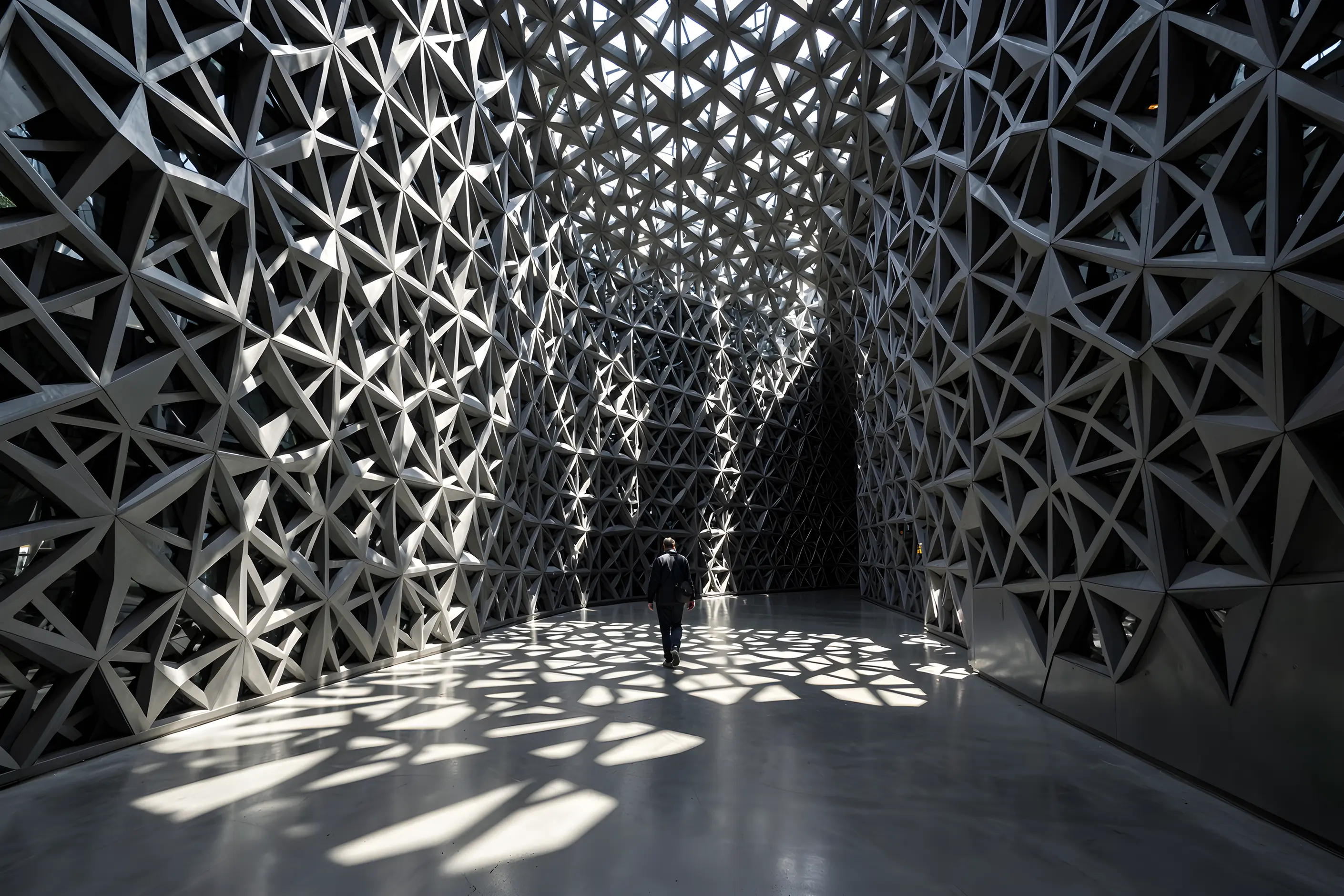
pattern systems that need to read as rigorous and potentially infinite rather than merely decorative, and functional screens doing genuine solar shading. It is not a generic “Middle Eastern” mood, and treating it as one is the fastest way to misuse it.
Islamic art developed across fourteen centuries, from the Islamic world’s early centuries through to the present, spreading across three continents from Spain to Indonesia. Because religious contexts generally discouraged figurative imagery, this tradition channelled its creative energy into three primary modes: geometric pattern, calligraphy and arabesque, the abstracted vegetal ornament also known by that French term.
The reasoning behind that avoidance, aniconism, is specific rather than absolute. The Quran does not explicitly prohibit imagery. Hadith, sayings attributed to the Prophet Muhammad, express concern that image-making rivals God’s own creative power, and the wider Islamic prohibition against idolatry reinforced a wariness toward figurative representation.
That wariness applied most strictly in religious settings. Mosques and Quranic manuscripts generally avoided figurative imagery, while secular settings, palaces, manuscript illustration and the decorative arts, often included it, particularly in Persian, Ottoman and Mughal work. The restriction, in other words, tracked context rather than applying uniformly across the whole civilisation.
The theological concept of tawhid, the absolute oneness of God, directly shaped the resulting aesthetic. Because God was understood to transcend all form and comparison, figurative representation of the divine was considered inappropriate, and abstract patterns carrying qualities such as infinity and order became an appropriate vehicle for religious expression instead. Islamic patterns often build complex visual effects from a single generating principle, which reflects the same theological idea: the many emerging from the one.
Calligraphy’s status rests on a related but distinct claim. Islam understands the Quran as God’s literal word, divine speech revealed to Muhammad rather than merely inspired text, and that understanding elevated Arabic calligraphy to unique sacred status. Writing the Quran became an act of worship, and traditional training could involve years of practice under a master, spiritual preparation and, ultimately, an ijaza, formal authorisation to sign one’s own work.
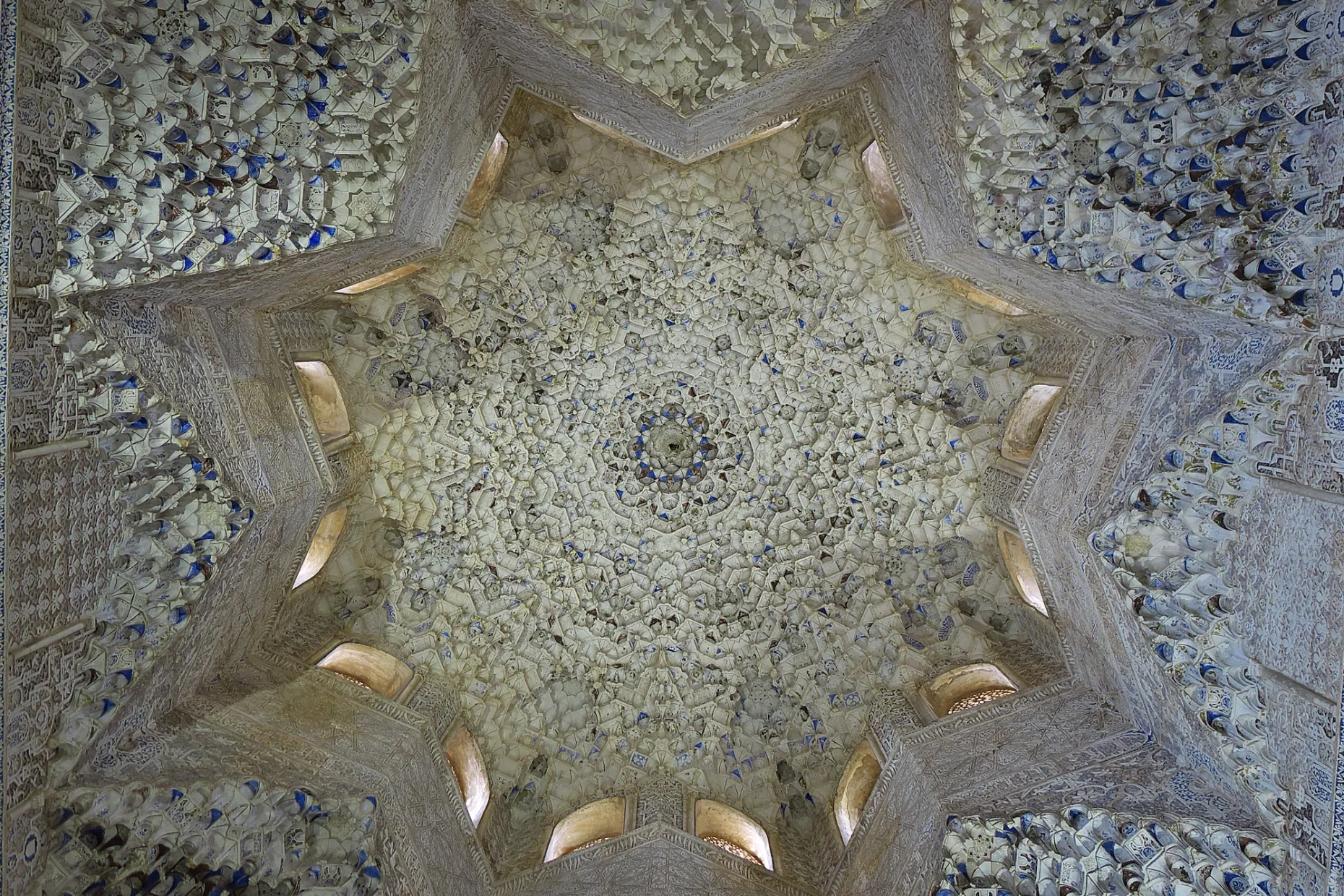
The clearest surviving architectural statement of all three modes together is the Alhambra in Granada, Spain, where geometric pattern, calligraphy, arabesque and muqarnas honeycomb vaulting combine in a single palace complex. Persian tile programmes, Ottoman architecture under Sinan and Iznik ceramics, and Mughal pietra dura stone inlay culminating in the Taj Mahal each developed the same three modes into distinct regional character.
| Element | What this tradition does | The tell |
|---|---|---|
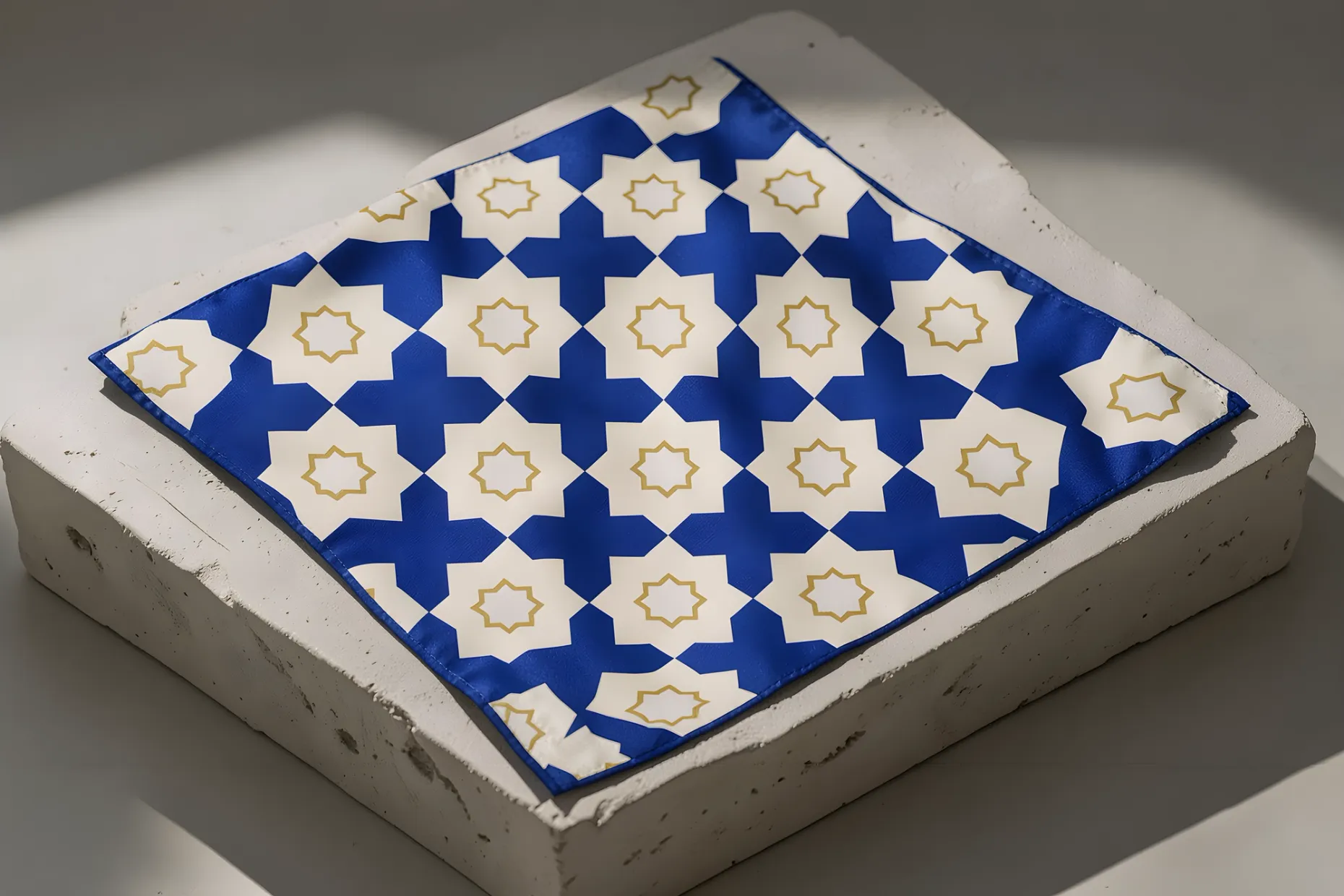
| Colour | Uses tilework and manuscript pigment in a bounded regional palette, from Iznik’s blues, greens and the ceramic red particular to that workshop, to the turquoise and cobalt of Persian and Moroccan glaze | Saturated blue, turquoise or white glaze against a repeating geometric ground, rather than a broad or naturalistic palette |
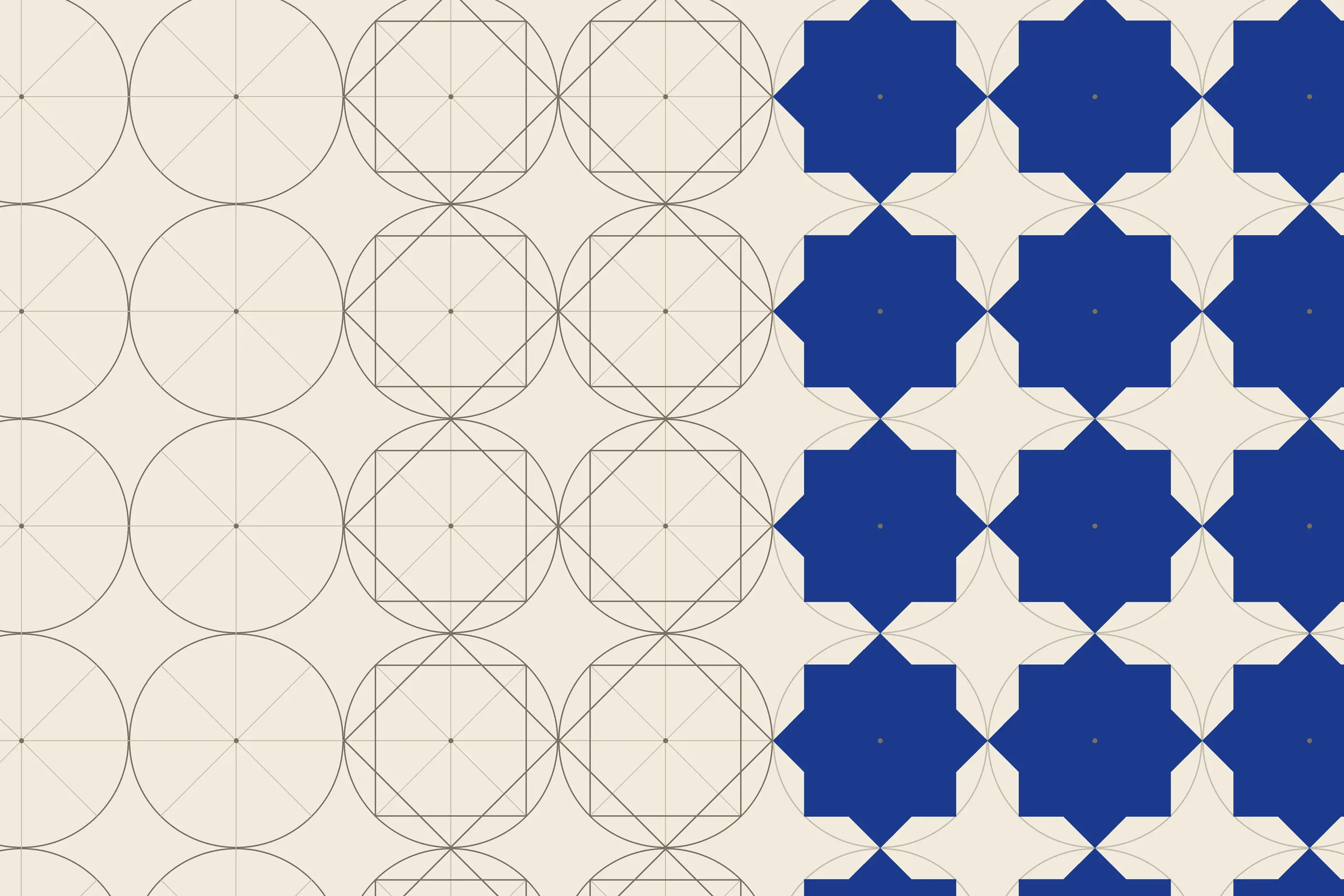
| Form and pattern | Builds star-and-polygon systems from circles and their divisions, using compass-and-straightedge construction and rotational symmetry, most often 6, 8, 10 or 12-fold | An interlocking star pattern radiating from a point, extending without an implied edge or vanishing point |
| Typography and calligraphy | Raises Arabic script to primary ornament, in scripts ranging from angular Kufic through the codified proportions of Naskh to the dramatic display forms of Thuluth | Text that is also the image: a Quranic verse or inscription doing the compositional work a painted figure would do elsewhere |
| Layout and composition | Fills the surface edge to edge, geometry, calligraphy and arabesque layered by scale, large structure to fine vegetal detail, with no isolated focal figure | Hierarchy created by the scale of pattern and the placement of inscription, not by a single subject set apart from its ground |
| Materials and texture | Works in glazed cut tile, carved stucco and stone, inlaid semi-precious stone and painted or gilt manuscript, with muqarnas built up from many small repeated units | Individually shaped, cut or carved pieces assembled into one larger geometric field, visible as construction rather than smoothed away |
| Imagery and ornament | Abstracts the arabesque from observed plant growth, vines, leaves and flowers, into continuous scrolling pattern rather than botanical illustration | A scrolling vine that suggests infinite growth and belongs to no single identifiable species |
| Neighbour | What it shares with Islamic design | What separates them |
|---|---|---|
| Sacred Geometry | Geometric and proportional systems read as carrying meaning beyond decoration | Sacred Geometry gathers proportional claims from many unrelated cultures, and some of those claims are modern or mystical readings rather than documented historical practice. Islamic geometric pattern’s rationale, tawhid and aniconism, is stated in named theological sources and applied in dated, located buildings, not inferred after the fact |
| Tessellation and Pattern Systems | The mathematics of tiling, rotational symmetry and repeat structure, including girih tiles as a documented case of intricate interlocking tiling | Tessellation and Pattern Systems teaches the general mathematics of tiling independent of any culture. Islamic design is the specific, named and dated body of religious and decorative work in which craftspeople developed and applied that mathematics for a stated theological purpose |
| Calligraphy Traditions | The elevation of writing itself to the status of high art | Calligraphy Traditions surveys the craft across Arabic, Chinese, Japanese and Western scripts side by side. Islamic calligraphy is the Arabic-script tradition specifically, and its particular status rests on the Quran being understood as God’s literal word, which makes writing it an act of worship rather than a craft applied to a sacred subject |
Construct geometric patterns from a named symmetry system and circle-based construction, not from tracing a reference image freehand. Establish whether the pattern is 6, 8, 10 or 12-fold before you extend or adapt it, since the rotational system determines every subsequent decision.
Reserve Quranic calligraphy and mosque-specific compositional forms, a complete Quranic verse, a mihrab-shaped niche panel, for contexts where their religious meaning is intended and respected. Do not use them as decorative texture in secular work.
Name the specific regional tradition you are drawing from: Andalusian and Moroccan zellige, Persian tilework, Ottoman Iznik ceramic, Mughal pietra dura, rather than reaching for a generic label. Each has its own materials, palette and history, and naming it correctly is part of using it well.
Where the brief wants the pattern logic without any religious content, model it on secular applications, solar-shading screens and non-devotional geometric ornament, rather than mosque or Quranic material. Credit the tradition in your documentation. Pastiche risk in this style is high and specific: a vaguely Arabic-styled custom lettering standing in for real Arabic script, or a scattering of arabesque motifs used as atmosphere rather than construction, reads as costume rather than reference.
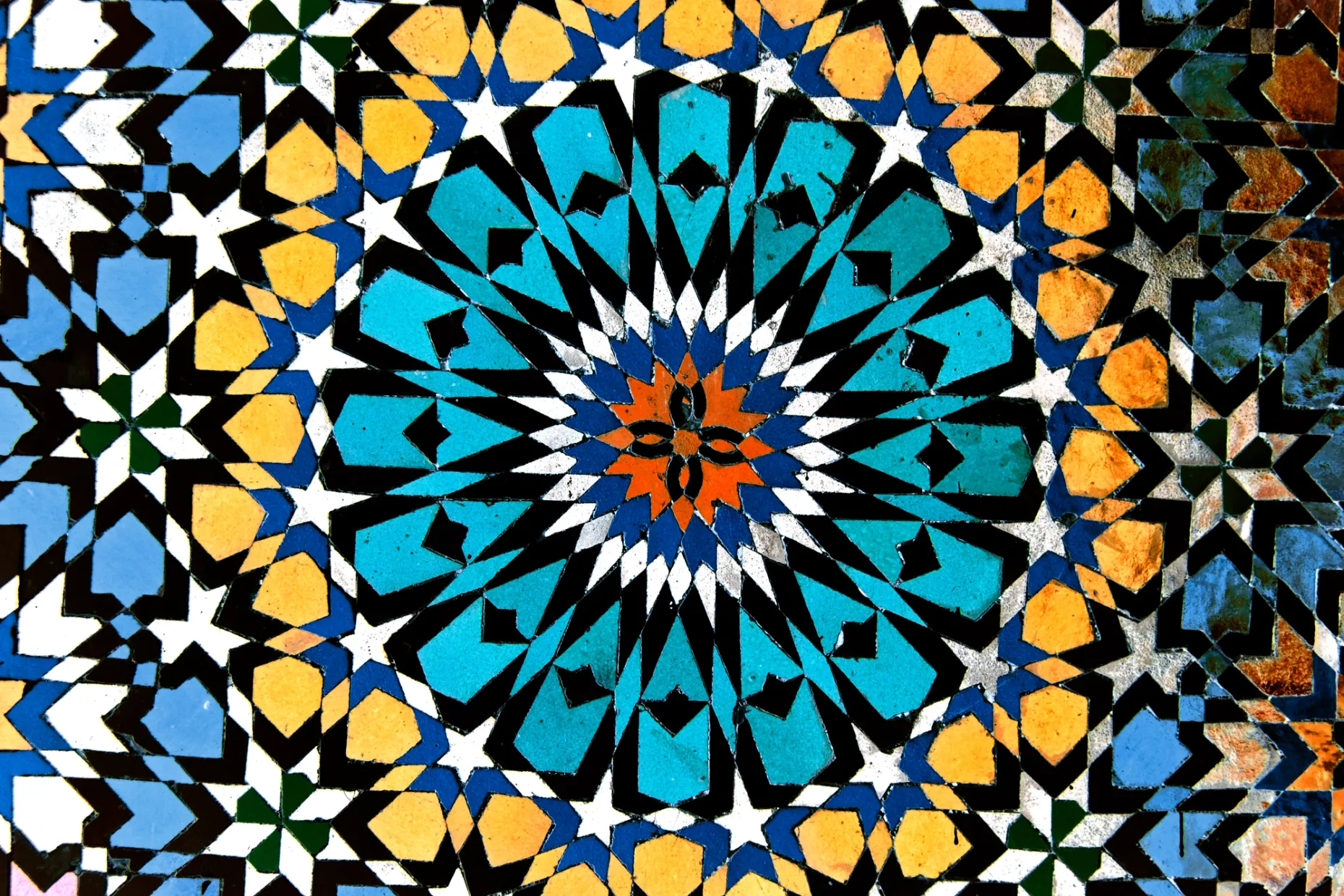
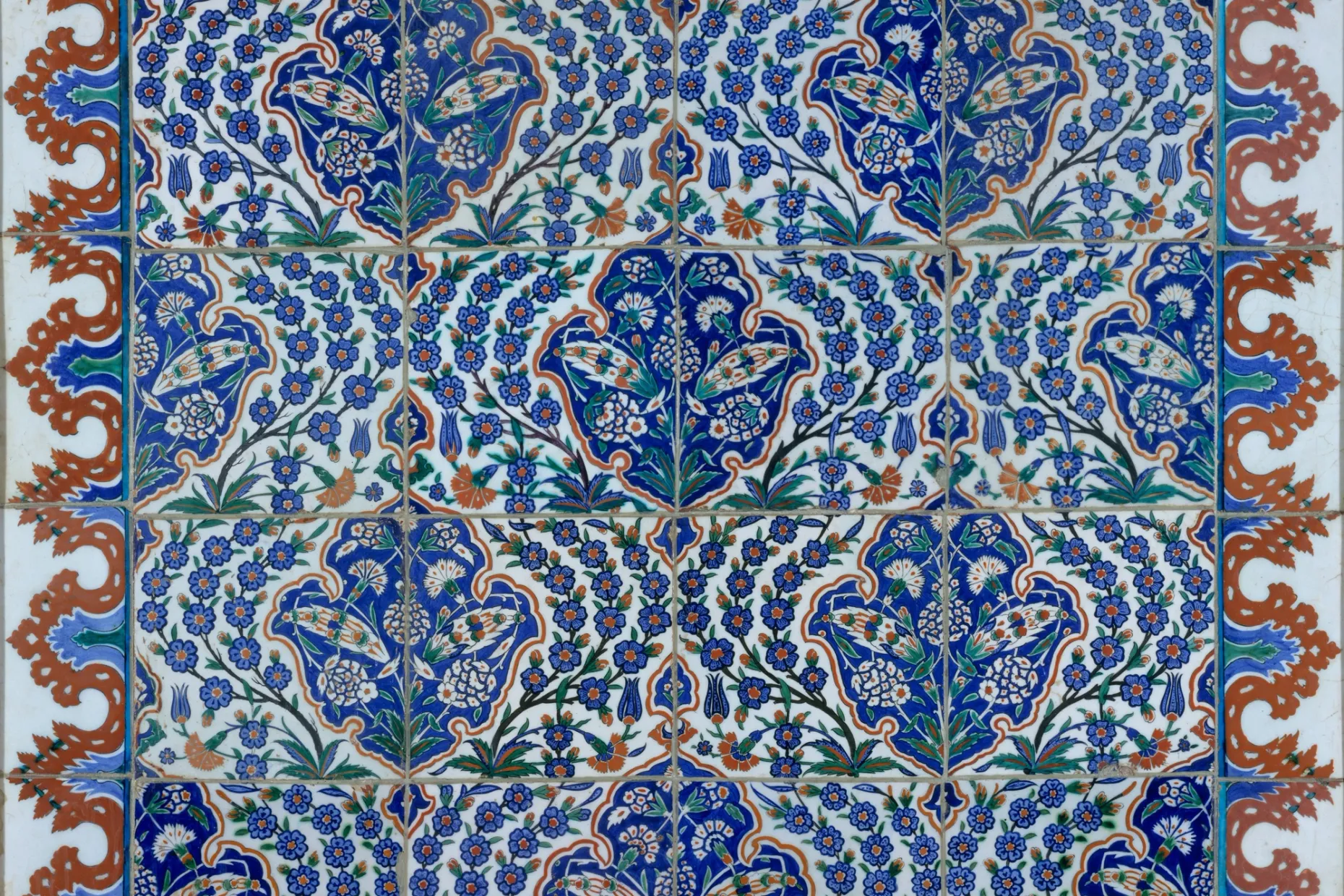
Reduced to mood, this tradition collapses into “Middle Eastern” ornament: generic scrollwork, an invented script that only resembles Arabic, applied for atmosphere with no underlying geometry or meaning. That collapse also flattens genuinely distinct regional traditions, Andalusian, Persian, Ottoman and Mughal, into a single imagined aesthetic, when the source traditions differ from each other in palette, technique and even in how strictly they observed figurative restriction.
Appropriation here has a specific shape, and it deserves a direct answer. Quranic calligraphy and mosque decoration serve, and continue to serve, religious purposes for a global Muslim population, and using them in secular or inappropriate contexts can cause real offence. The difference between a reference and a costume is attribution and understanding: a reference names the tradition, region and period it draws from and treats a sacred or ceremonial form as still meaning something to the people who use it. A costume borrows the look, presents a religious inscription or form as generic exotic texture, and lets the viewer assume the pattern was invented for the project rather than inherited from a living tradition.
The style also carries a practical limitation. Its characteristic density, filling a surface edge to edge, does not suit a brief that wants restraint or negative space, and applying that density without the underlying construction logic reads as clutter rather than rigour.
No. The Quran does not explicitly prohibit imagery, and the restriction came from hadith concerned that image-making rivals God’s creative power, reinforced by a wider prohibition against idolatry. It applied most strictly in religious settings; secular Persian, Ottoman and Mughal work often included figures.
What is tawhid, and why does it matter to the patterns? Tawhid is the theological principle that God is one, without partner or comparison, and beyond all form. Because figurative representation of the divine was inappropriate under that principle, abstract geometric patterns, capable of suggesting infinity and order, became a fitting vehicle for religious expression instead.
Are girih tile patterns really connected to quasi-crystal mathematics? Analysis of Persian girih tiling systems has found mathematical sophistication that anticipates concepts later formalised as quasi-crystalline geometry in the West. That is a finding about the sophistication of the historical tiling method, not a claim that the original craftspeople worked from modern crystallography.
What is the difference between zellige and Iznik tilework? Zellige is the Moroccan tradition of individually cut, coloured tile pieces assembled into a geometric mosaic. Iznik is Ottoman Turkish painted ceramic tile, known for its floral motifs and distinctive red, and it uses a different material process than cut-tile mosaic.
No. Sacred Geometry gathers proportional claims across many unrelated cultures, some of them modern readings. Islamic geometric pattern is one specific, dated and sourced tradition with a stated theological rationale, tawhid and aniconism, rather than an inferred mystical thread.
| Fact | Detail |
|---|---|
| Span | Fourteen centuries and three continents, from Spain to Indonesia |
| Three primary modes | Geometric pattern, calligraphy, arabesque |
| Central theological concept | Tawhid, the absolute oneness of God |
| Reason for figurative restriction | Hadith concern that image-making rivals God’s creative power, reinforced by the prohibition against idolatry, applied most strictly in religious contexts |
| Naskh proportions codified by | Ibn Muqla, tenth century |
| Rotational symmetries used | 6, 8, 10 and 12-fold |
| Defining building | The Alhambra, Granada, Spain |
| Defining architectural innovation | Muqarnas, honeycomb vaulting |
| Regional schools | Andalusian and Moroccan (zellige), Persian (tilework, Nastaliq script), Ottoman (Iznik ceramic, architect Sinan), Mughal (pietra dura, the Taj Mahal) |

Sacred geometry treats certain geometric forms and proportions, among them the golden ratio, the Platonic solids, and the Flower of Life, as evidence of a divine or cosmic order laid over mathematics that is otherwise plain and checkable.
Read it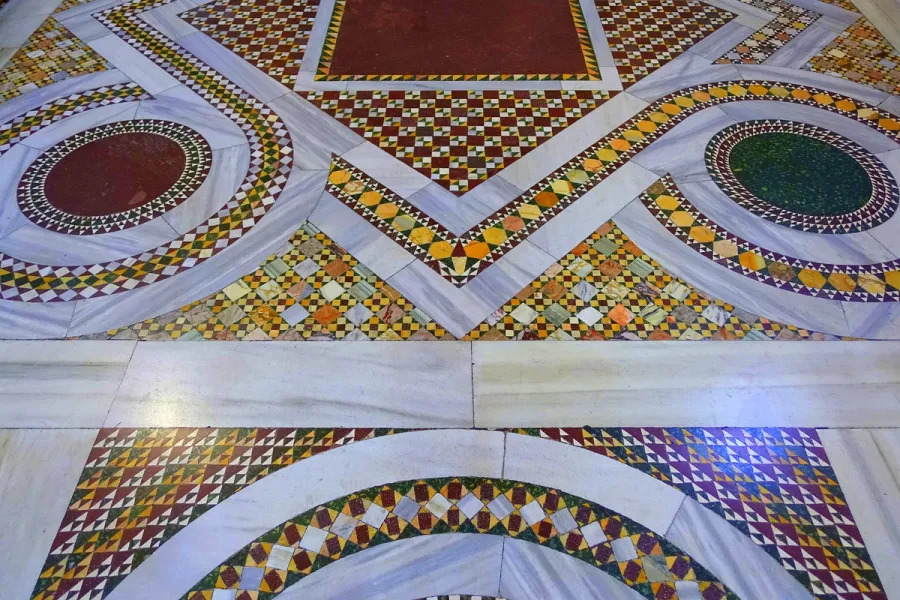
Tessellation is the covering of a plane with shapes that meet edge to edge, with no gaps and no overlaps, and it follows a small, provable set of mathematical rules rather than taste.
Read it
Calligraphy is the practice of beautiful handwriting: letters formed in one continuous, tool-determined stroke rather than built up through repeated passes.
Read it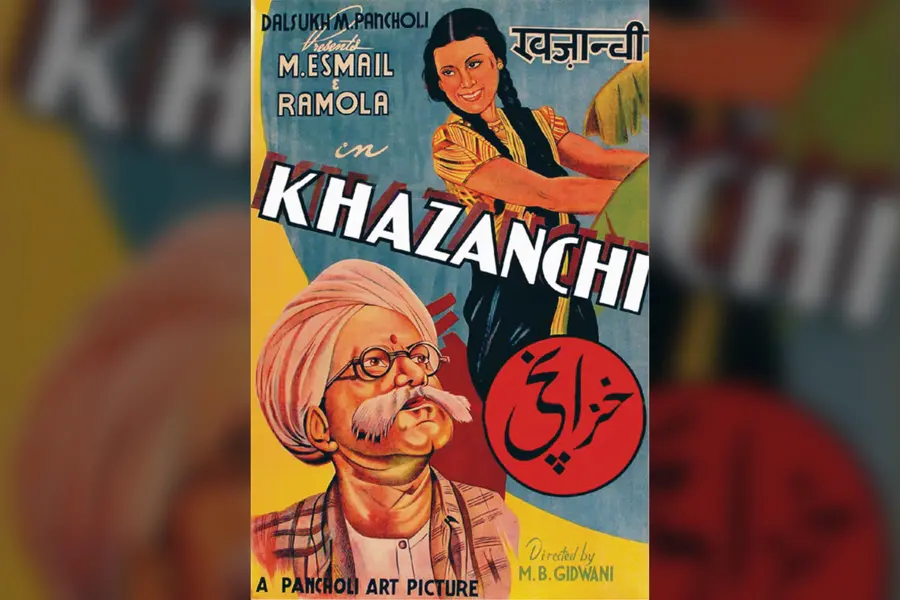
Indian design is not one visual culture but several, layered across a subcontinent where Hindu, Buddhist, Jain, Islamic and Sikh traditions have shared and contested the same regional ground for centuries.
Read it
Filigree is a metalworking technique in which fine wire, usually gold or silver, is twisted, curled and soldered into open, pierced ornamental patterns.
Read it