
2026-09-15
Nural Choudhury
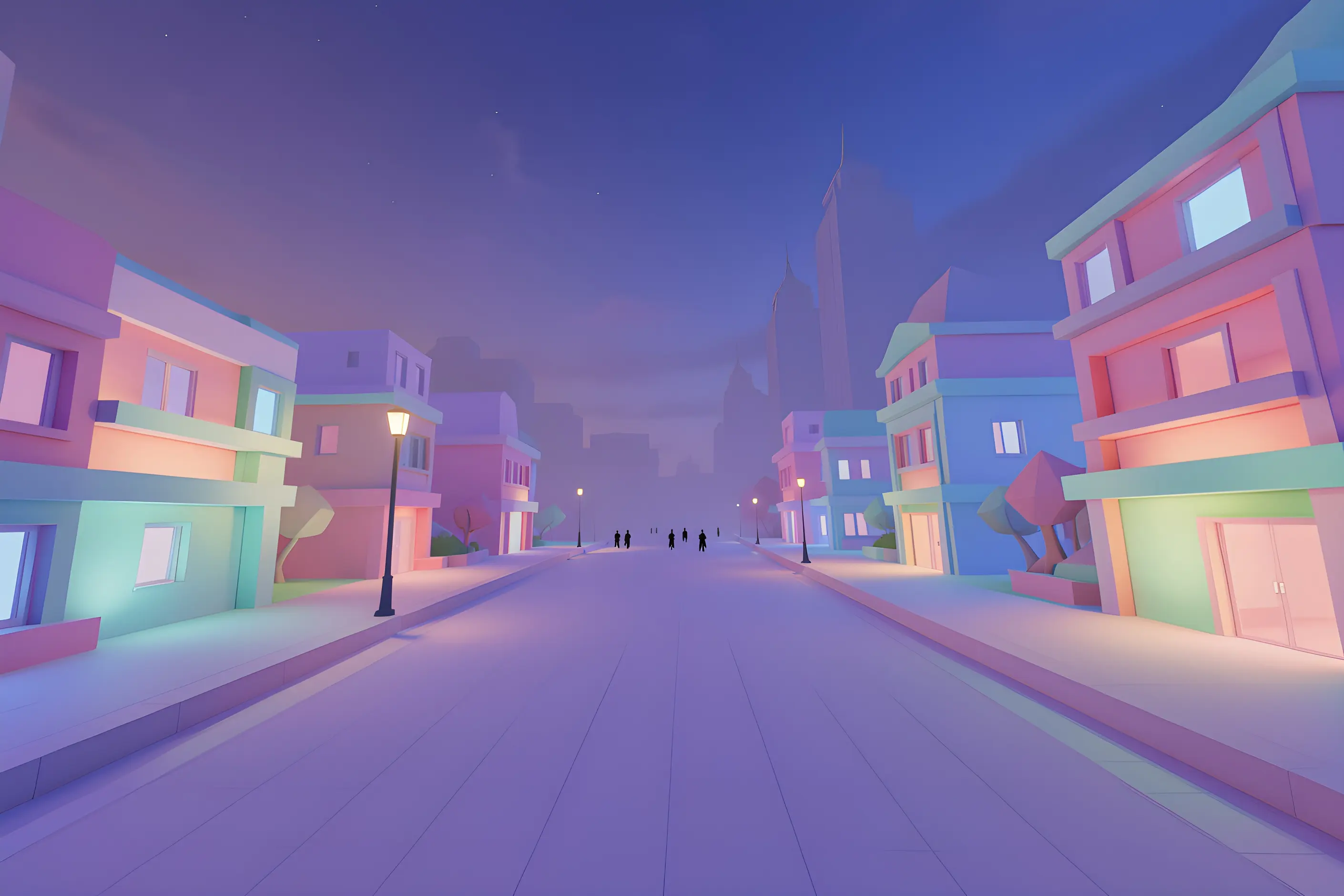
Metaverse design is the discipline of building persistent, shared virtual worlds where people are present through avatars rather than screens: spaces that keep existing, keep changing and keep accumulating history whether or not any particular user is logged in.
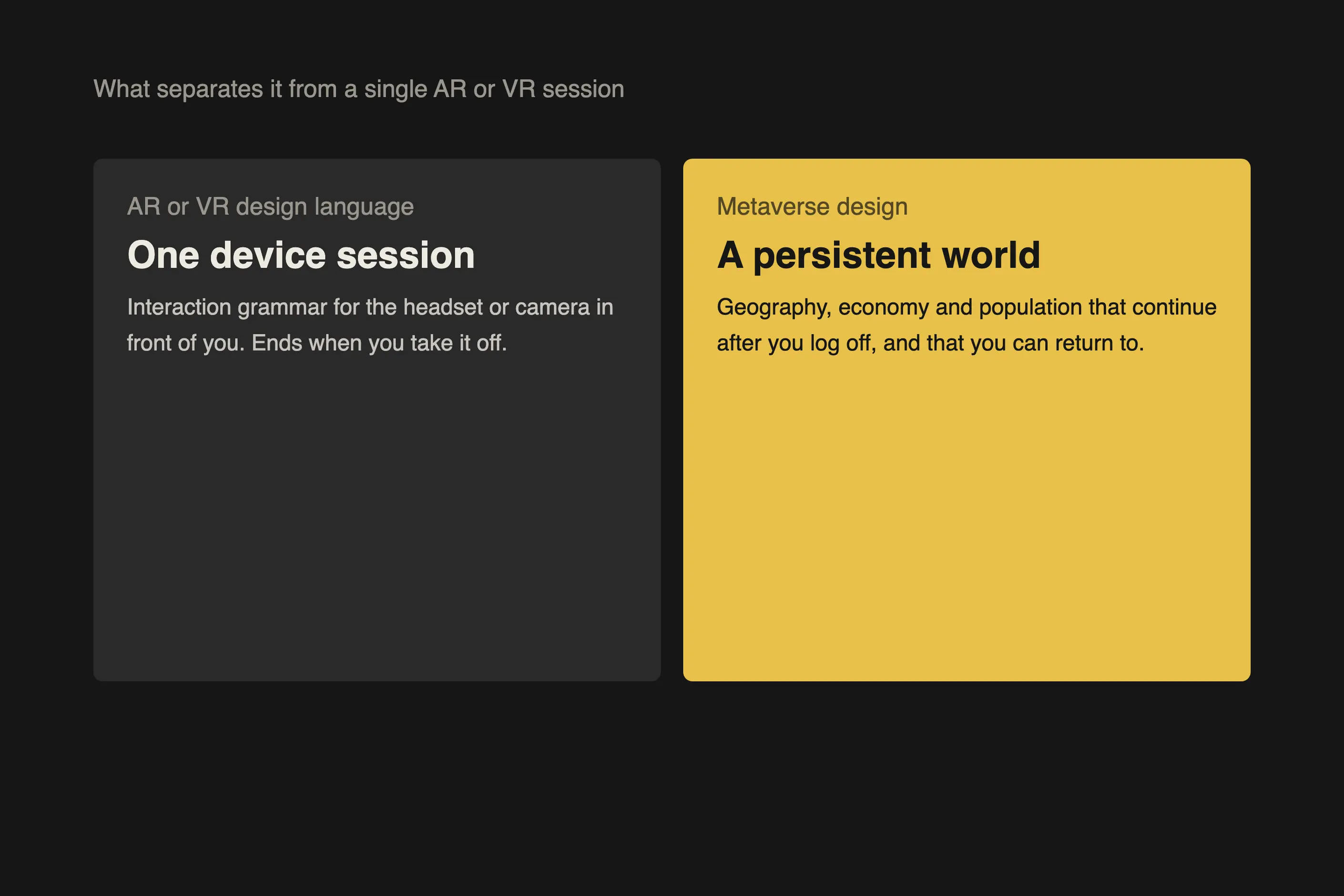
It is not a visual style, and it is not a headset. Where AR/VR design languages define the interaction grammar for a single device session, metaverse design governs the world that session drops a user into, a world with its own geography, economy and population that persists across sessions, devices and, ideally, platforms.
a space with zoning (commercial plazas, quiet districts, event venues), a customisable avatar as the unit of presence, visible other users sharing the same instance, and some form of ownable digital good, whether cosmetic, land or currency. The environment shows wear, events and change over time rather than resetting.
the convergence of gaming platforms that outgrew single sessions (Fortnite, Roblox, Minecraft), social VR platforms built for gathering rather than competing (VRChat, Horizon Worlds, Rec Room), and blockchain-based worlds built around ownable land and items (Decentraland, The Sandbox).
persistent social spaces, community platforms, virtual events and collaborative or training environments where continuity between visits matters more than a single task.
The discipline draws on several established practices rather than originating in one. Game design supplies engagement mechanics and player psychology. Architecture supplies spatial organisation and environmental storytelling. Urban planning supplies the logic of how districts connect and how communities form around shared geography. Fashion design supplies avatar expression, and UX design supplies usability in spatial contexts with no established conventions yet.
Current platforms fall into three recognisable categories. Gaming platforms such as Fortnite, Roblox and Minecraft began as games with discrete sessions. They evolved into persistent social spaces once creative tools and social features extended their life beyond a single match. Social VR platforms such as VRChat, Horizon Worlds and Rec Room were built for gathering rather than competing, with game elements present but subordinate to social presence. Blockchain-based worlds such as Decentraland and The Sandbox built digital ownership into the world itself, treating land and items as tradeable assets and making economic design central rather than incidental. Enterprise and corporate initiatives form a fourth, quieter category, applying the same spatial and social principles to collaboration and training rather than consumer socialising.

| Element | What this discipline does | The tell |
|---|---|---|
| World coherence | Holds lighting, materials, art direction and scale to a consistent internal logic across every district, even where regions differ in character | A fantastical zone and a technological zone coexist only where a transitional zone or narrative device bridges them; unexplained tonal jumps read as unfinished |
| Avatar systems | Treats the avatar as the unit of presence, not decoration: appearance, animation and facing direction carry identity and emotional state | Customisation ranges from sliders and presets to modular part libraries; the platform’s chosen method, rather than its range, signals whether it prioritises expression or coherence |
| Spatial organisation | Zones large worlds into commercial, social, creative and quiet districts, and uses density gradients to move users from busy plazas toward private space | Clear public-to-private gradients, plaza-to-alley progressions; a world without zoning reads as an unstructured asset dump |
| Wayfinding | Combines memorable environmental landmarks with directional cues and, where needed, UI-based maps | Landmarks are visible from a distance and unique in silhouette; over-reliance on minimaps instead of environmental cues signals a world not designed to be legible on foot |
| Social infrastructure | Supports proximity awareness, spatial voice, text and gesture, and gives clear attention signals so users know who is addressing whom | Multiple parallel conversations can happen in the same plaza without acoustic or visual bleed between them |
| Digital economy | Designs scarcity deliberately, since digital goods have no inherent scarcity, through limited runs, time windows or earned-only items | Ownership is visibly displayed through worn items, property signage or status indicators, rather than sitting invisibly in an inventory |

| Neighbour | What it shares | What separates them |
|---|---|---|
| AR/VR design languages | Both concern embodied presence and spatial navigation, and both often run on the same headset | AR/VR design languages define the interaction grammar for a single device and session: depth cues, comfort, field of view. Metaverse design defines the persistent world itself, meant to outlast and remain device-agnostic across any single session |
| Web 3.0 aesthetics | Both frequently sit on the same blockchain-based platforms and share a vocabulary of ownership and digital scarcity | Web 3.0 aesthetics is a visual style built from grids, neon and wireframe motifs applied to interfaces and brands. Metaverse design is the discipline of building the inhabitable space itself, whether or not it carries that look |
| Generative design systems | Both can populate large worlds procedurally, and both treat a system, not a single artefact, as the unit of authorship | Generative design authors an algorithm that produces content. Metaverse design authors a persistent, multi-user environment that people inhabit, alter and return to; the algorithm is one possible tool inside it, not the deliverable |
Establish internal logic before art direction. Decide what is physically consistent across the world, which materials behave predictably, and whether gravity applies everywhere before building a single asset. Retrofitting consistency after user-generated content arrives is far harder than setting the rule first.
Zone the world before populating it. Assign commercial, social, creative and quiet districts and design density gradients between them so users move naturally from busy plazas toward private space, rather than dropping every feature into one undifferentiated area.
Design the avatar system to the platform’s actual priority. Choose sliders, presets, modular parts, or a layered system based on whether the platform needs expression, coherence, or both, and set style parameters such as polygon budgets and animation standards that maintain that balance rather than leaving it to individual creators.
Design scarcity and ownership display deliberately wherever the platform carries a goods economy. Digital items have no inherent scarcity, so decide what limits supply, and make ownership visible through worn items, signage or status indicators, not buried in an inventory screen.
Plan for the empty-space problem from the start. A plaza built for a hundred users looks dead with five. Decide in advance how spaces read at low population, through ambient life, NPC presence or a space that scales down with attendance.
Where a platform allows user-generated content, set content guidelines and moderation before coherence collapses. You must decide, deliberately, whether the platform embraces visual variety as its aesthetic or holds a strict baseline; leaving it undecided produces neither.
The commonest failure is the empty-space problem: spaces designed and rendered for crowds that read as dead, abandoned and unwelcoming the moment population drops, which is most of the time for most spaces on most platforms. A second is coherence collapse under open user-generated content, where a world without style guidelines or moderation degrades into an unstructured asset dump that undermines any sense of a designed place.
A third is the gap between the sales pitch and the platform. The fully interconnected, seamlessly portable metaverse described in marketing remains aspirational: avatar portability and cross-platform asset transfer are still largely unresolved, and a world sold as boundless often turns out to be a single walled platform with a persistence gimmick. Treat interoperability claims with the same scepticism you would apply to any unproven technical promise.
A fourth is safety and moderation failure. Shared, persistent, socially dense spaces concentrate the same harassment and crowd-management problems as physical public space, and a platform that has not built blocking, reporting and visible moderation infrastructure before scaling its population will not retrofit safety once harm has already occurred.
Finally, the discipline’s own synthesis is a pastiche risk. Borrowing engagement mechanics from games, spatial thinking from architecture and identity expression from fashion without genuinely integrating them produces a world that feels like several disciplines’ offcuts stacked in one place rather than a coherent design practice.
Is the metaverse the same as VR? No. VR is one entry point among several, alongside desktop and mobile, and a metaverse platform’s defining trait is persistence and shared social presence, not the headset used to reach it.
Does a platform need a blockchain to count as a metaverse? No. Gaming platforms and social VR platforms built persistent, socially dense worlds without on-chain ownership. Blockchain worlds are one category among several, distinguished by how they represent ownership, not by whether persistence exists.
because they were designed and rendered for peak crowds and given no plan for low population. Design for how a space reads with five users, not only with a hundred.
as much as the platform’s balance of expression against coherence requires, set through explicit style parameters, not through unconstrained freedom that undermines visual consistency or restriction so tight it flattens identity expression.
The biggest risk in relying on interoperability between platforms is that it does not yet reliably exist. Avatar portability and cross-platform asset transfer remain largely unresolved, so treat any interoperability promise as aspirational until you can verify it against the specific platforms involved.
| Fact | Detail |
|---|---|
| Discipline blend | Game design, architecture, urban planning, fashion design, UX design |
| Gaming-origin platforms | Fortnite, Roblox, Minecraft |
| Social VR platforms | VRChat, Horizon Worlds, Rec Room |
| Blockchain-based platforms | Decentraland, The Sandbox |
| Population density bands | Intimate 2 to 5 users, social 5 to 20, crowded 20 to 100, mass 100 or more |
| Status of full interoperability | Aspirational; avatar portability and cross-platform asset transfer remain largely unresolved |

Spatial computing redesigns interfaces by moving from flat, screen-based displays to three-dimensional, depth-aware experiences.
Read it
Web3 aesthetics is the visual language of interfaces built for decentralised applications: cryptocurrency wallets, trading interfaces, and other blockchain-native tools.
Read it
Generative design systems set parameters, constraints, and goals, then let an algorithm search the space of possible solutions instead of drawing one outcome by hand.
Read it
An interface pattern is a solution to a recurring design problem, refined through enough use elsewhere that the person encountering it doesn’t have to figure out how to use it.
Read it
Digital accessibility is the practice of building products people can use, whatever their permanent, temporary, or situational disability, measured against a published standard rather than opinion.
Read it
A design system is a governed set of reusable components, patterns and rules that a team uses to build consistent digital products at scale, and it is neither a static style guide nor a component library on its own.
Read it